Learn pencil solving through authentic grids, handwritten candidates, guided deductions and printable exercises.
Learn pencil solving through authentic grids, handwritten candidates, guided deductions and printable exercises.
A real pencil-and-paper method
The rules do not change when you leave the screen: each row, column and 3×3 box must contain the digits 1–9 once. What changes is the work you must do. No cell automatically highlights its peers, no pencil mark vanishes by itself, and an incorrect entry may go unnoticed. A short, repeatable paper routine makes these tasks manageable.
The recommended order
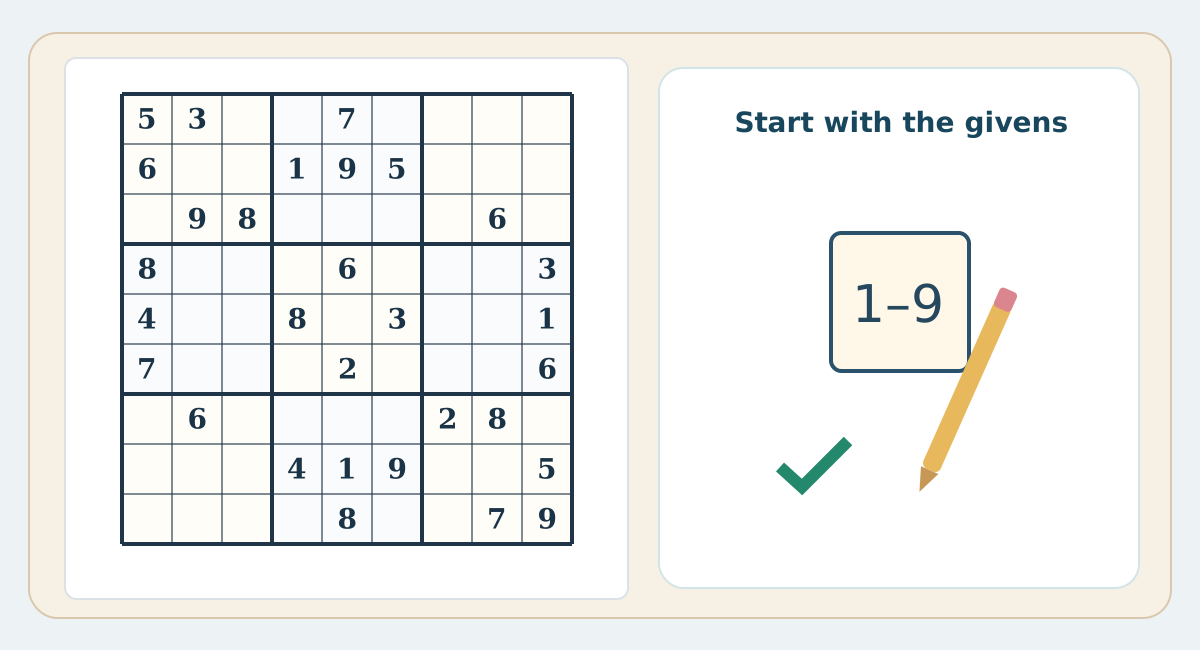
Start with scanning, then practise small and consistent pencil marks. Learn naked and hidden singles before pairs. Keep a log of why a candidate was removed, and revise only the affected row, column and box after each confirmed placement. The lessons below build on a single verified example grid, not an invented set of conflicting numbers.
Practise without extra software
Use the printable exercise pages with a pencil and eraser. Reveal the explanation only after recording your own conclusion. For an honest paper challenge, turn off digital hints while working, and use the online game only afterward to compare your reasoning. There is no requirement to register or purchase anything.
A five-step repeatable routine
Sit comfortably and read the givens without writing. Pick a crowded row, column or box and scan a missing digit. Annotate only necessary candidates, place only justified numbers and refresh their peers before moving on.