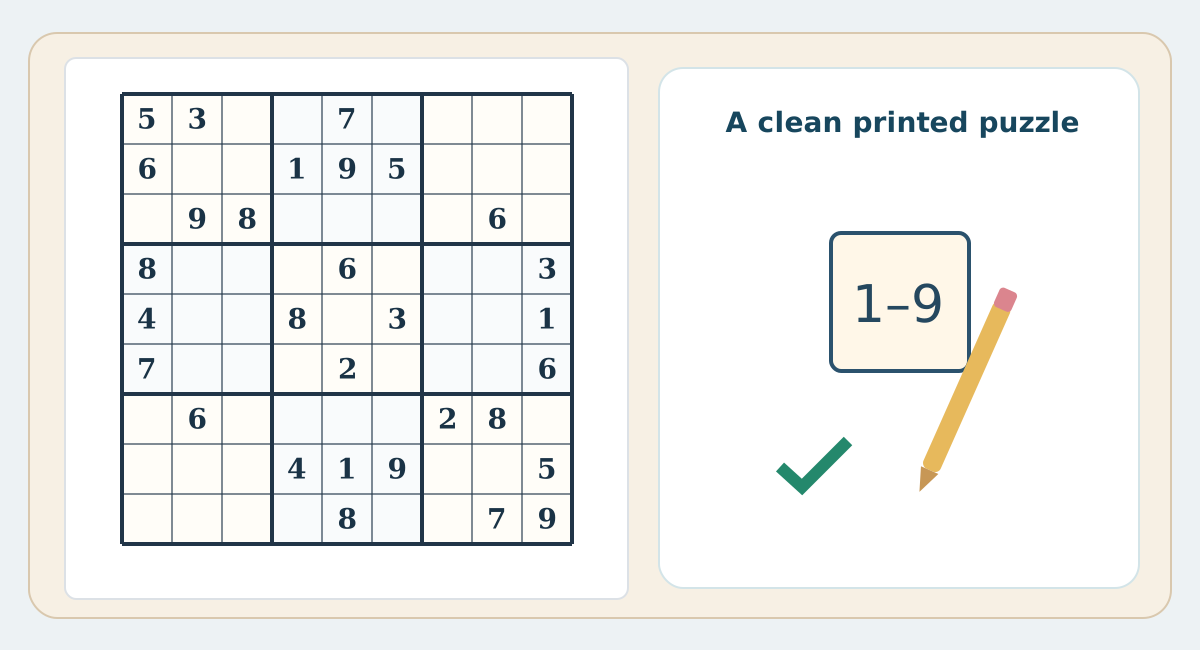
Minutes 0–4: survey the grid
Read the givens and identify well-filled units. Scan for digits that are missing from a nearly complete row, column or box. Mark only a few candidate cells instead of filling all pencil notes immediately. Choose a grid you can comfortably print and read.
Minutes 4–12: record defensible moves
For each possible placement, write a brief reason: 'naked single in r5c5' or 'only position for 5 in row 3'. Verify the affected row, column and box before filling the digit. If you reach a pair, record what the pair eliminates, not an unproved guess at the pair's order.
Minutes 12–17: practise one challenging technique
Spend a few minutes on a hidden single or a legitimate naked pair. If the puzzle does not contain the pattern, do not invent one. You may instead use the dedicated exercise pages in this course; they isolate known facts without distorting a real Sudoku grid.
Minutes 17–20: explain and review
Pick two filled cells and explain their logic without looking at a digital answer. Check the latest erased notes, record one mistake you avoided or one new habit you learned, and stop if you are tired. Repeat a few days a week; understanding matters more than finishing every puzzle in a fixed time.
Set a goal before solving
Avoid trial and error. First aim to prove four starting singles such as r5c5, r7c6, r7c9 and r8c8, then look for hidden singles. Record each reason in the margin; reveal answers only after attempting the exercise, or print a sheet without solutions.