Prepare your sheet
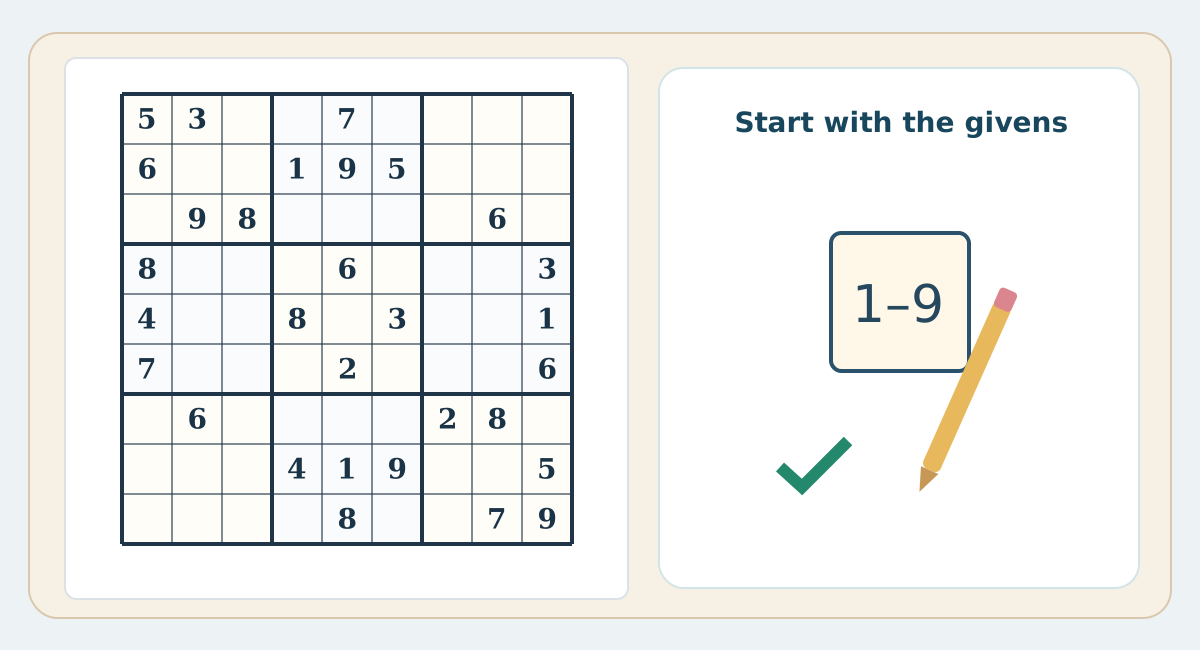
Print a grid large enough to annotate. Use one dark pencil for confirmed digits, light pressure for candidates and a clean eraser. Never overwrite the printed clues: the givens are the puzzle's fixed facts. Label rows 1–9 from top to bottom and columns 1–9 from left to right, so r5c5 always means the central cell.
Scan before writing candidates
Select a box with several givens and ask which digits it lacks. Check its crossing rows and columns. Do not guess a number because it looks plausible. In the worked grid, row 5 already contains 4, 8, 3 and 1. Column 5 contains 7, 9, 6, 2, 1 and 8. Their combined restrictions force r5c5 to 5.
Record each placement once
After writing 5 in r5c5, scan row 5, column 5 and the central box again. Erase 5 from any pencil notes in their other empty cells. Leave distant cells alone until the next scan. This small discipline avoids the common mistake of changing half the page after every number.
A five-step repeatable routine
Sit comfortably and read the givens without writing. Pick a crowded row, column or box and scan a missing digit. Annotate only necessary candidates, place only justified numbers and refresh their peers before moving on.