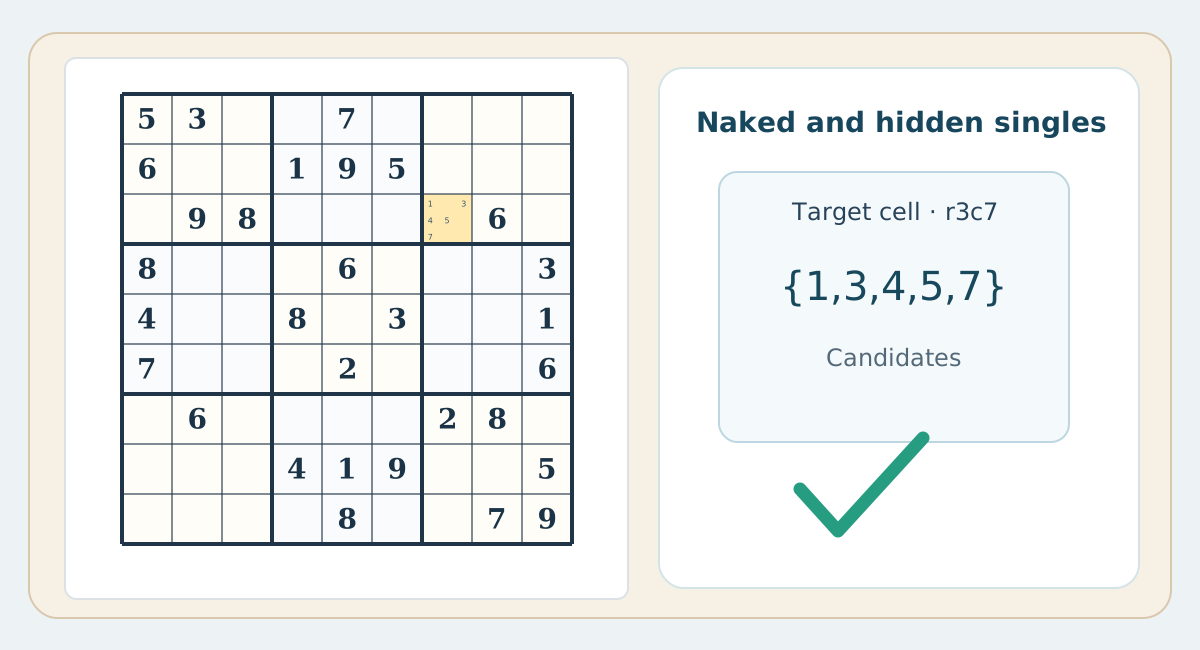
Naked single: one legal digit in a cell
The candidates of r5c5 are {5}; therefore its value is 5. This is a naked single because the cell itself has only one legal possibility. Other starting singles in the same example include r7c6=7, r7c9=4 and r8c8=3. Do not confuse a sole pencil note with a valid single if your notes were not refreshed.
Hidden single: one home for a digit
Look for the digit 5 in row 3 of the original grid. Several cells have multiple candidates, but only r3c7 can accept 5 within that entire row. Thus r3c7=5 even though its initial candidate set is {1,3,4,5,7}. The deduction is about the position of the digit in the row, not the number of notes in the cell.
How to check by hand
For a naked single, scan the chosen cell's row, column and box. For a hidden single, select one missing digit and scan every empty cell in the chosen unit. Write the outcome only when you have ruled out every alternative position. Repeat the proof before pressing the pencil more firmly.
Identify the kind of single
A naked single has one legal digit in its own cell after all constraints. A hidden single is the only available position for a digit within a whole unit, even if that cell has multiple candidates. Compare r5c5=5 with r3c7=5.