Never place a digit from one constraint
A digit being absent from a row does not prove it belongs in a particular cell. It must also be legal in the column and box and follow a valid single or other logical deduction. Record all three restrictions before enlarging a pencil entry.
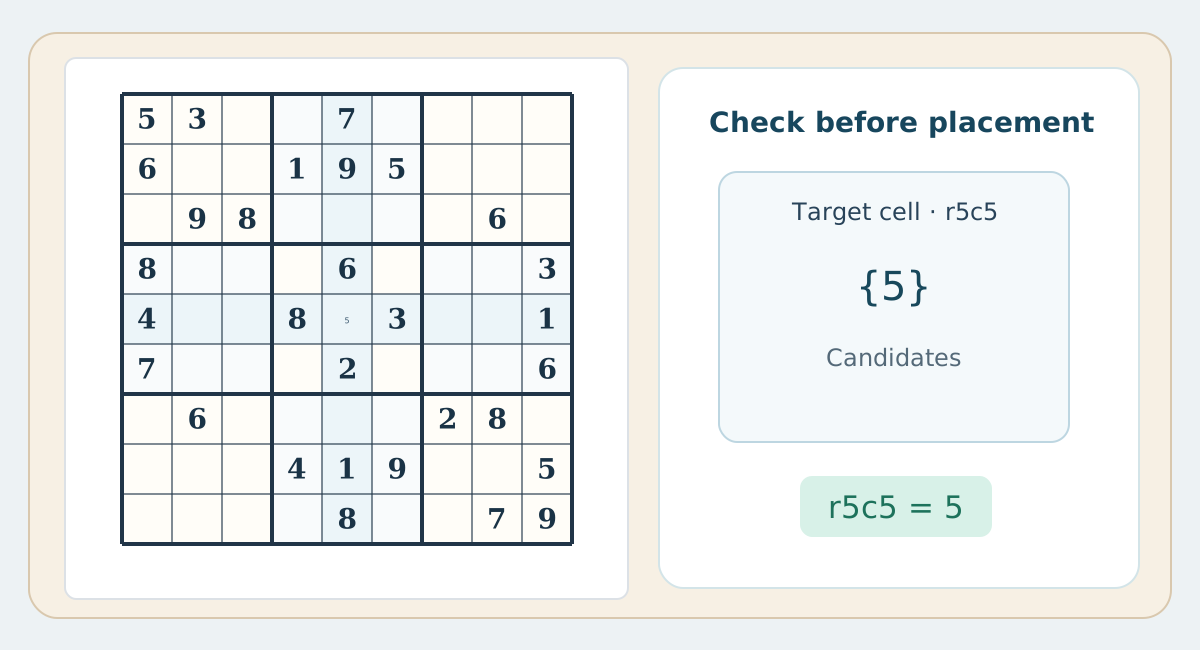
A checkable example: r5c5
In the included puzzle row 5 lacks {2,5,6,7,9}, while column 5 lacks {3,4,5}. Their intersection is just 5, consistent with the central box. Write 5 clearly and remove that candidate from any affected notes.
Recognize a hidden single
A cell can contain several candidates while one digit can go nowhere else in its unit. Check every blank cell of row 3: digit 5 has only r3c7 as a legal position. Do not confuse this with a cell having just one possible digit.
Final verification
Before writing a digit permanently, ask whether you eliminated all other possibilities, whether you can explain the proof in one sentence, and whether earlier moves changed any related notes. If one answer is uncertain, leave it as a candidate.