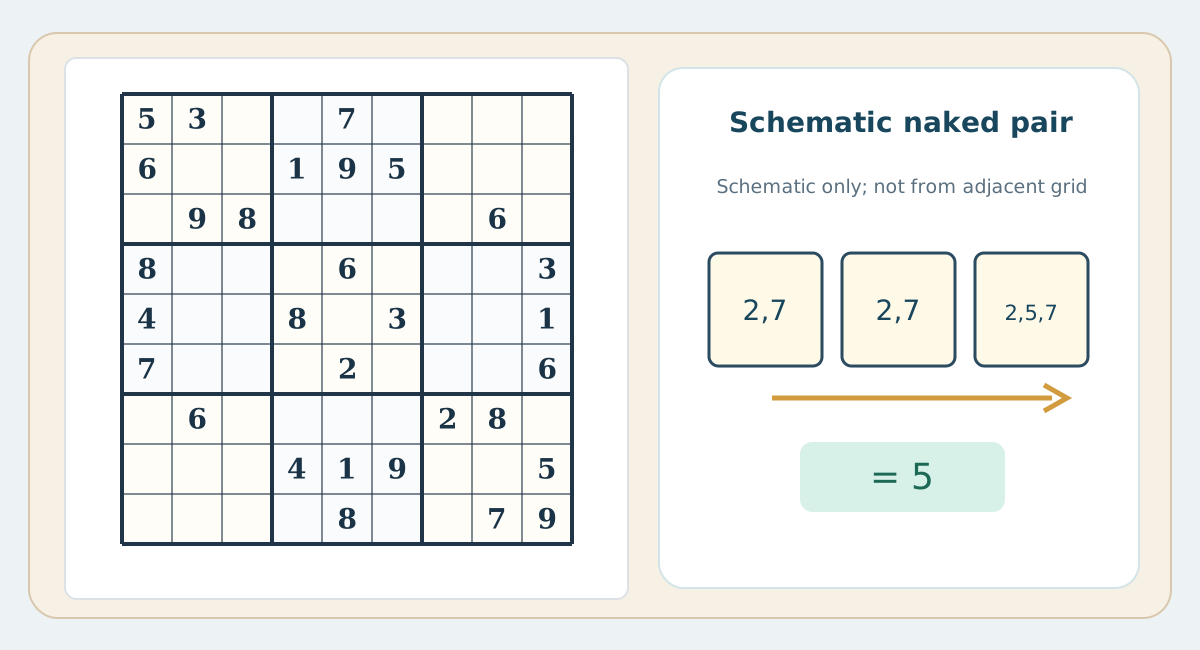
A genuine naked pair
If exactly two cells in the same row contain only {2,7}, those two digits must occupy those cells in some order. You may erase 2 and 7 from other cells in that row. You may not erase them from the whole grid, and you cannot decide which of the pair cells contains 2 yet. The same rule applies to a column or a box.
Locked candidates: a useful boundary
If every possible position for digit 6 inside one 3×3 box lies in the same row, 6 cannot occur in that row outside the box. Mark which box and which row support the claim. The reverse direction also works when a row's possible positions for a digit all lie in one box.
Paper checklist before erasing
Check that the two pair cells really have no third candidate, that they share the same unit, and that the target of your elimination is in that unit but outside the pair. For a locked candidate, make sure no possible location was overlooked. If any premise is uncertain, keep the note and continue solving elsewhere.
What a pair actually proves
In a hypothetical row, two cells with exactly {2,7} reserve those digits in some order. Their order is not yet known, but you may eliminate 2 and 7 from other cells in that row only. No eliminations are justified outside the shared unit.