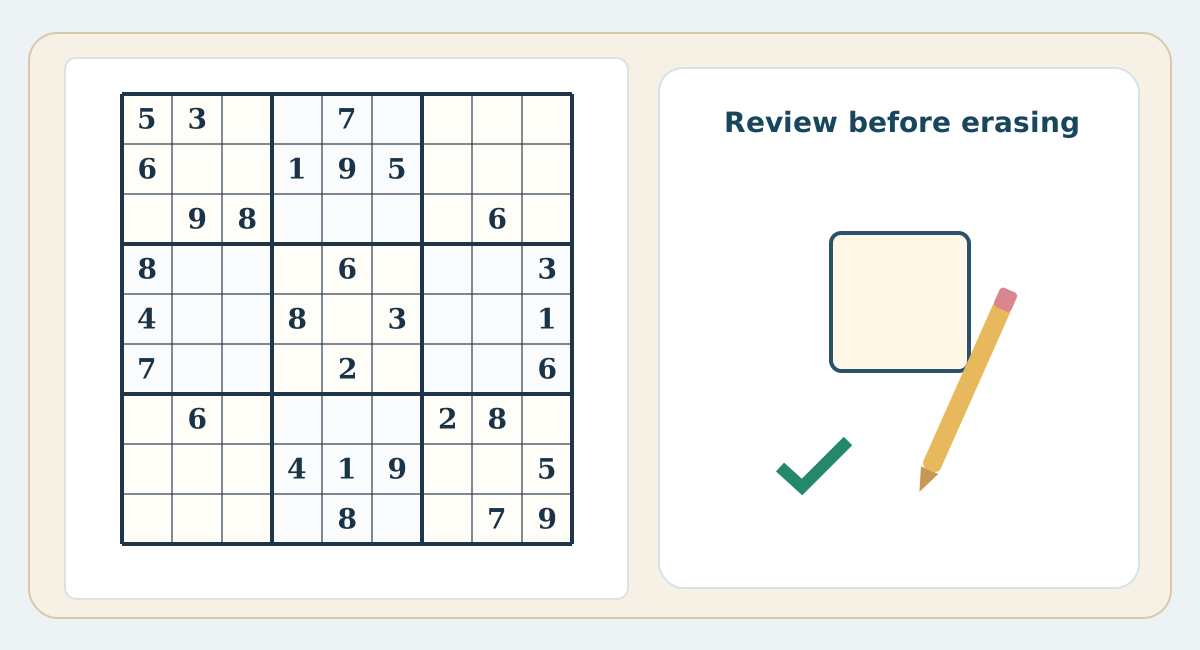
1–3: Notes that mislead you
First, writing candidates after scanning only the row ignores restrictions from the column and box. Second, failing to erase an invalid candidate after a new placement makes future scans misleading. Third, mixing strong handwritten answers with faint candidate marks makes them easy to confuse. Fix these by scanning all three units and choosing a consistent writing style.
4–5: Guessing and over-erasing
Fourth, a cell with two candidates is not a permission to guess one. Fifth, erasing an entire region after noticing a contradiction destroys information that may still be correct. Instead, keep the two alternatives in pencil, search a different unit and revisit your earliest questionable deduction with a small correction.
6–7: Poor page management
Sixth, cramped or unevenly written notes are difficult to read under weak light. Seventh, changing printed givens or treating an erased smudge as a valid digit breaks the puzzle. Print at a comfortable scale, keep a clear margin for reasoning, and always distinguish original clues from your own entries.
A simple self-audit
When progress stops, ask: have I checked every row, column and box for the chosen digit? Did I update notes after each confirmed placement? Are my eliminations justified by a known rule? Are the original clues unchanged? This checklist often reveals an overlooked single without restarting.
Preserve the deduction trail
Inspect the most recent entered number and the rule behind it. If it was not justified, erase it and recompute only its affected peers; many other notes may remain correct. A single margin note such as '5 fixed at r5c5' can help reconstruct the deduction.