A separate schematic exercise
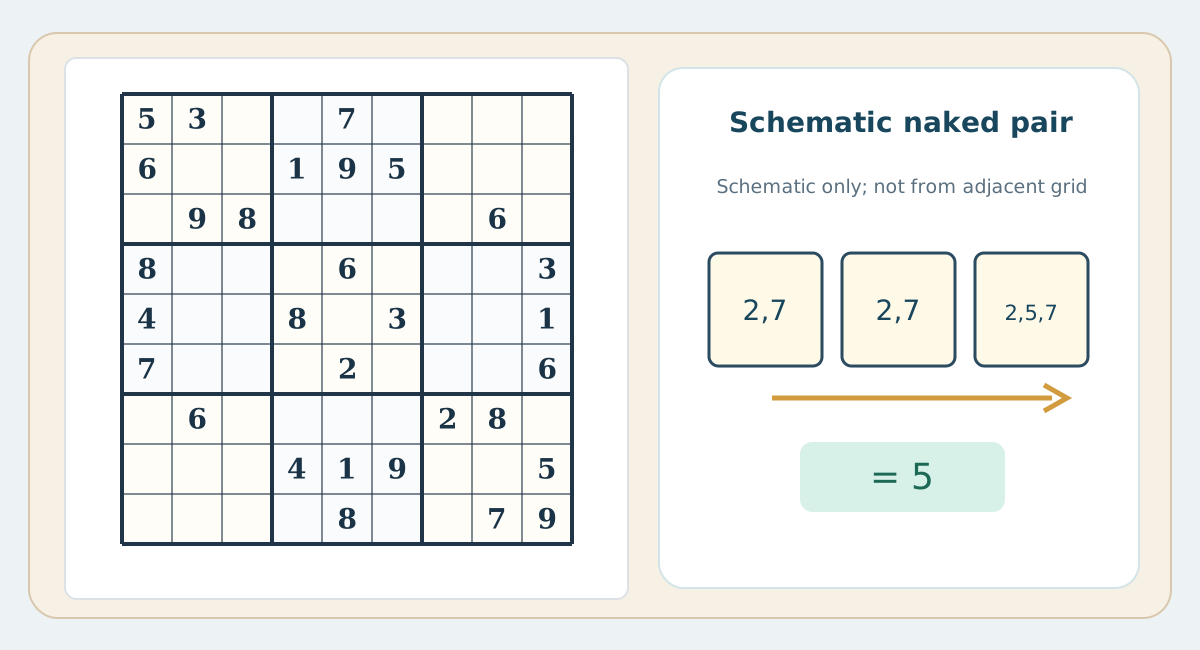
Imagine a schematic row with exactly two cells whose legal candidates are {2,7}, and a third cell with candidates {2,5,7}. Since the two digits must occupy the first two cells in some order, which marks may be removed from the third?
Identify the shared unit
The naked pair authorizes elimination only within the shared row. A candidate outside that row is not affected merely by this pair. Mark the row boundary on your printed sheet before crossing out anything.
Never guess the pair order
The first two cells still accept both numbers. You cannot decide which is 2 or 7 without another deduction. The exercise teaches elimination in a third cell, not an unsupported guess about pair order.
Check your deduction
Removing 2 and 7 from {2,5,7} leaves {5} in the third cell, provided all three cells share the row and the original pair really has only those two candidates.
Worksheet
🖨 Print worksheet only| 5 | 3 | 7 | ||||||
| 6 | 1 | 9 | 5 | |||||
| 9 | 8 | 6 | ||||||
| 8 | 6 | 3 | ||||||
| 4 | 8 | 3 | 1 | |||||
| 7 | 2 | 6 | ||||||
| 6 | 2 | 8 | ||||||
| 4 | 1 | 9 | 5 | |||||
| 8 | 7 | 9 |
Reveal answer and reasoning
Schematic row: if exactly two cells contain only {2,7}, remove those digits from the third cell {2,5,7}, leaving {5}. The pair does not determine which of the first two cells is 2 or 7.