Begin with a specific cell
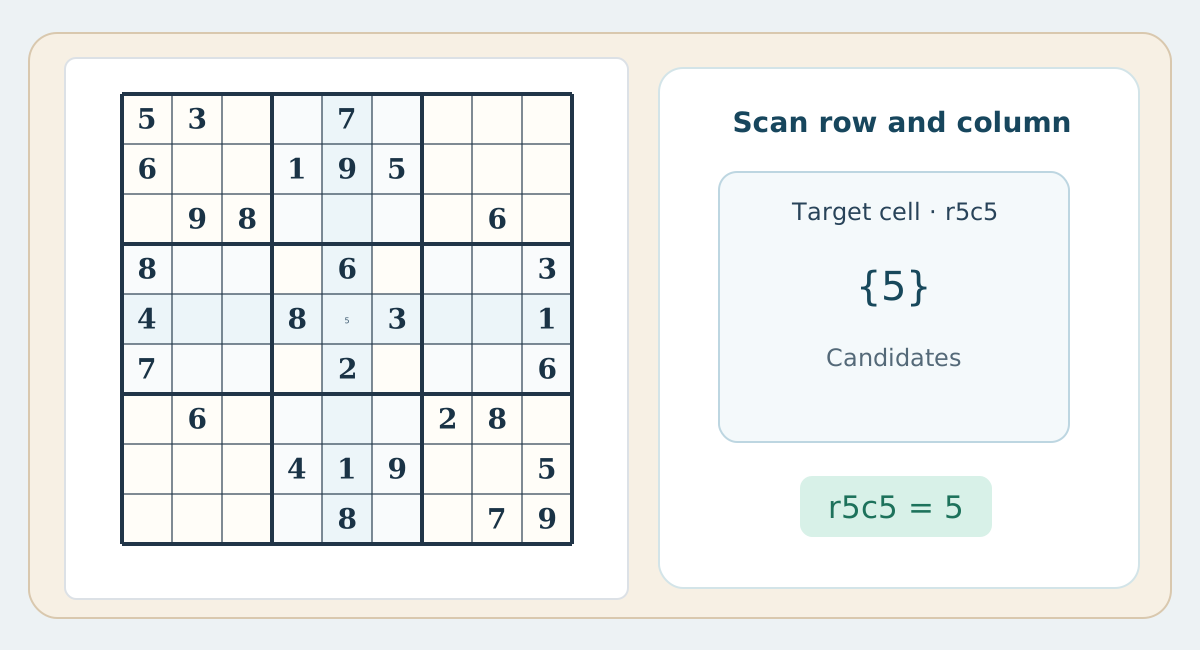
At r5c5 in our example, the row contains 4, 8, 3 and 1. Its missing digits are {2,5,6,7,9}. The column contains 7,9,6,2,1,8, so the missing digits are {3,4,5}. Only 5 belongs to both sets; checking its 3×3 box confirms it does not clash.
Trace the three directions on paper
Rest a finger or a straightedge under row 5, and then trace column 5. Circle the central 3×3 box lightly if it helps. Use pencil marks to record what remains, not a sequence of guesses. Remove the temporary guides after the deduction so the page stays readable.
Know when you are not done
If two candidates remain, stop and leave both as notes. Scanning does not magically choose one. Move to a different constrained cell or look for a hidden single within a whole row, column or box; come back when a new confirmed placement removes a possibility.
Prove r5c5 step by step
Row 5 misses {2,5,6,7,9}. Column 5 misses {3,4,5}. Only {5} belongs to both lists; the central box permits it too. Therefore r5c5=5 without any digital hint.