Distinguish a clue from your own entry
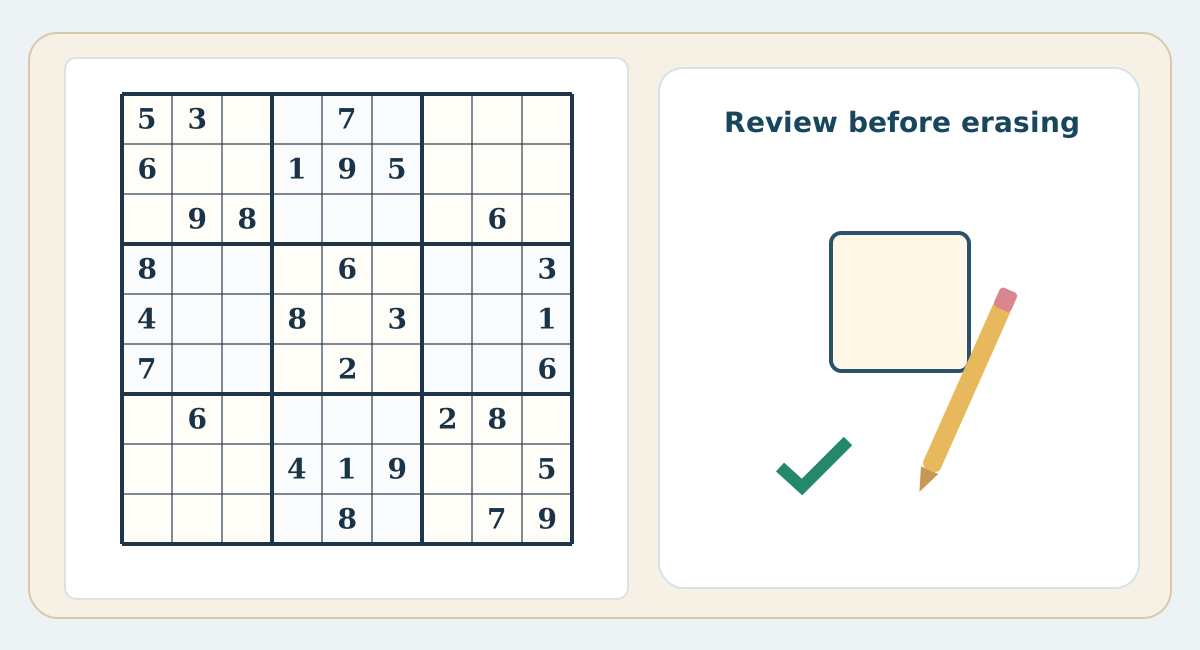
Never erase a printed given. Write your confirmed digits with a little more pressure than temporary candidates, but keep them erasable. When the same digit appears twice in a row, column or box, first compare the printed givens with your handwritten additions; the error may be in your deduction or a copied candidate.
Return to the last justified move
Mark the most recent filled cell with a tiny dot in the margin, along with the reasoning: for example, 'r5c5=5, row∩column'. If a contradiction appears, inspect that claim and the immediately preceding one. Rebuild candidates only for cells affected by the suspect placement; do not erase the whole grid.
Prevent smudges from becoming logic
A crossed-out candidate must have a known elimination rule. If you cannot remember the rule, recalculate the candidate from the present grid rather than relying on the strike-through. You can place a clean sheet beneath your writing hand to reduce smearing and keep one side margin for deductions.
Preserve the deduction trail
Inspect the most recent entered number and the rule behind it. If it was not justified, erase it and recompute only its affected peers; many other notes may remain correct. A single margin note such as '5 fixed at r5c5' can help reconstruct the deduction.