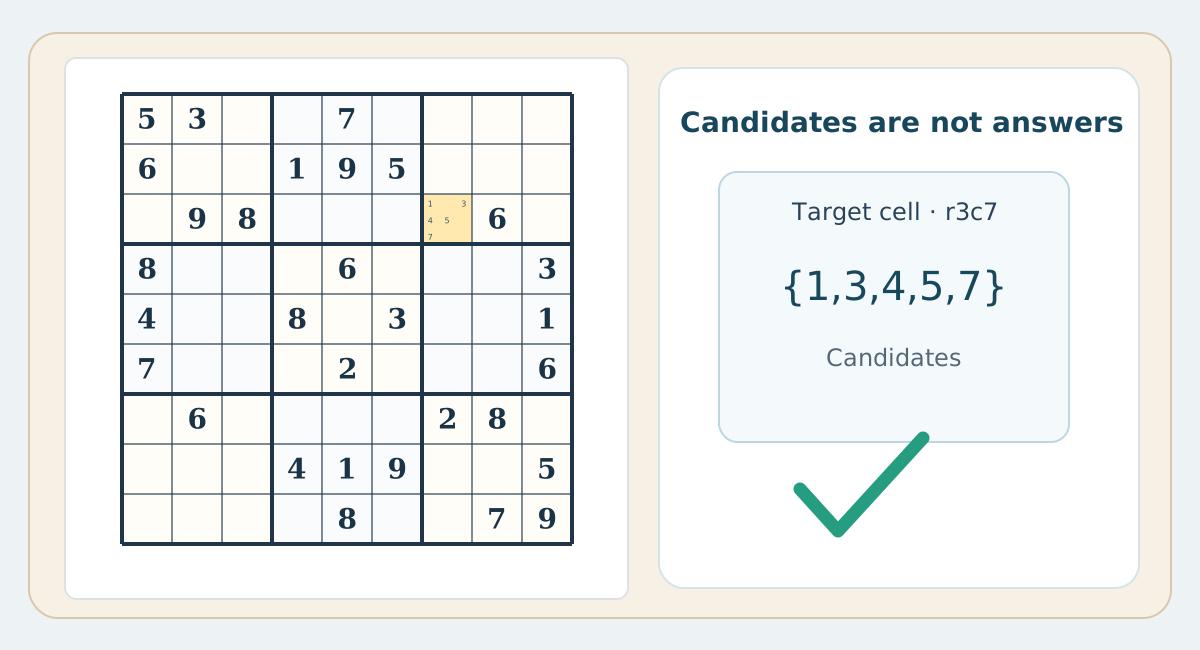
The nine-position convention
Many paper solvers reserve a tiny position inside each cell for each candidate: 1, 2, 3 across the top; 4, 5, 6 across the middle; 7, 8, 9 along the bottom. An ordinary list in one corner also works. Choose one system and stay consistent; the meaning of a note must be unambiguous.
Only list legal candidates
For each blank cell, subtract digits already present in its row, column and box from 1–9. In our verified example, r5c5 initially admits only {5}. Do not write a mixture of possible digits from merely one unit: the row, column and box must all agree.
Erase with a reason
Whenever a digit is placed, update only its peers. When a pair or locked candidate gives an elimination, write the reason in the page margin if the grid is crowded. A rubbed-out mark is not a proof: you should be able to say which rule made the digit impossible.
Avoid stale candidate marks
After placing a digit, only its peers may lose that candidate. Do not erase other marks without a reason. A tiny last-reviewed marker helps, and your small pencil digits should never look like full-size confirmed answers.