Sudoku variant course
Sudoku X
Classic rules plus both long corner-to-corner diagonals, each containing 1–9 exactly once.
Learn the extra rules, then answer a practice question with immediate feedback. This lesson does not change your player account or game progress.
Check rows, columns, boxes and diagonals
Every placement must satisfy the ordinary three regions. A cell on a main diagonal must also avoid digits already on that diagonal.
The center square is special
At row 5 column 5, both long diagonals meet. A number in the center constrains both diagonals as well as its row, column and box.
Avoid a common misunderstanding
Sudoku X applies only to the two long diagonals. Short diagonals elsewhere on the board do not gain extra rules.
See the two diagonals on the board
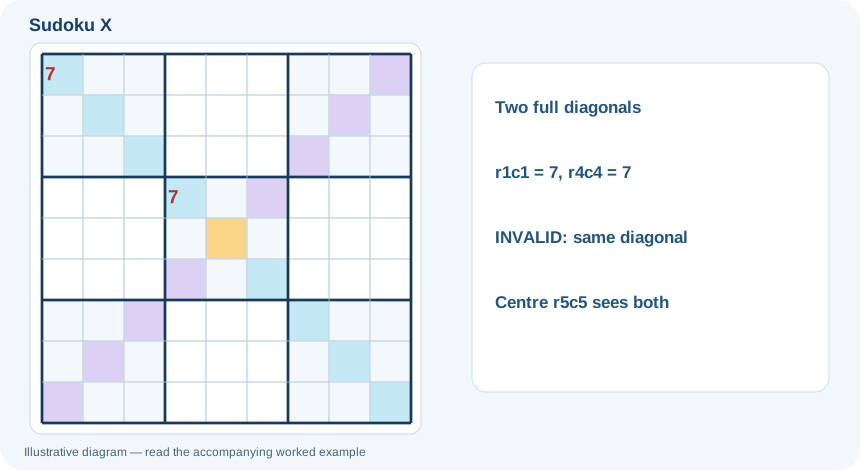
The descending diagonal runs from the upper-left corner through r5c5 to the lower-right corner: r1c1, r2c2, and so on to r9c9. The ascending diagonal runs from r1c9 through r5c5 to r9c1. Each diagonal is a separate nine-cell unit that must contain the digits 1–9 exactly once. Ordinary Sudoku rows, columns and 3×3 boxes still apply everywhere, including the cells that are not on a diagonal.
Worked example: a forbidden duplicate
Suppose r1c1 already contains 7. Then r4c4 cannot be 7, even though these cells have different rows, columns and 3×3 boxes. They are both on the descending diagonal, and that is enough to rule out the second 7. Now suppose r5c5 is unresolved: compare the digits already present on both diagonals with its row, column and central box. The available candidates at the center must survive all five checks. The highlighted cells in the diagram show the extra restriction; the diagram is not a complete puzzle.
A reliable solving sequence
First scan rows, columns and boxes for obvious singles. Next inspect the two diagonals independently: which digits are missing, and which intersection cells can take them? At the center, combine both diagonals rather than treating either in isolation. Return to the standard units after every placement. Record candidate eliminations before filling in a cell; the absence of a candidate on a diagonal does not automatically identify a value without checking the other constraints.
Try it yourself
On a blank annotated grid, mark 7 at r1c1 and a candidate 7 at r4c4. Explain why the latter must be crossed out even if its row, column and box admit 7. Then trace r1c9 to r9c1 and list all nine cells on the other diagonal. Finally, ask why a short three-cell slant inside a box has no special rule.
Check your understanding
How many long diagonals have the extra 1–9 restriction in Sudoku X?
Apply two extra diagonal constraints
Find the five units at the center
The center r5c5 participates in row 5, column 5, the middle 3×3 box, and both long diagonals. Candidate testing at that cell must respect all five units, unlike Classic. A candidate missing from the ordinary three units may still already exist on a diagonal.
Use one diagonal at a time
If digit 7 is already fixed at r1c1, remove 7 from every other unsolved cell on the main diagonal, including r8c8. This does not let you remove 7 from every cell of the opposite diagonal unless ordinary constraints provide a separate reason.
Train with a checklist
On a Sudoku X puzzle, list the nine cells of each diagonal and cross off filled digits. Identify a candidate that occurs in only one remaining diagonal position. Verify its row, column, and box as well before committing it.