Sudoku variant course
16×16 Sudoku
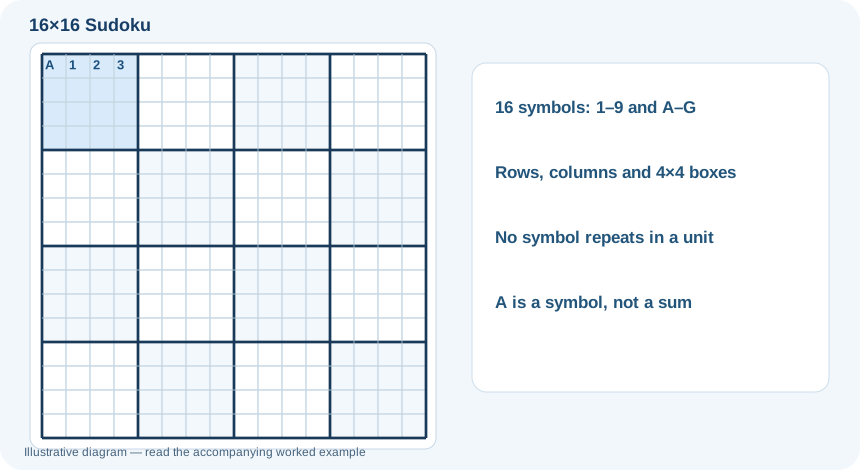
A larger 16×16 grid with sixteen symbols and 4×4 boxes. Every symbol appears exactly once in each row, column and box.
Learn the extra rules, then answer a practice question with immediate feedback. This lesson does not change your player account or game progress.
Understand the enlarged board
There are 256 cells, sixteen rows and sixteen columns. Each bold-bordered box is 4×4 rather than 3×3.
Use the full set of sixteen symbols
The game defines a set of 16 distinct symbols. Each one must appear once in each row, column and 4×4 box. Do not assume a standard 1–9-only input fits this variant.
Break the challenge into regions
Start from the 4×4 boxes with the most clues. Track the missing symbols, then intersect with row and column restrictions just as in classic Sudoku.
Sixteen symbols, not sixteen numbers to add
This variant uses a 16×16 board divided into sixteen 4×4 boxes. A consistent symbol set is 1–9 and A–G, representing sixteen distinct values. Each symbol must appear once in each row, column and 4×4 box. Letters are symbols here, not instructions to add or multiply. Check the symbol legend used by the actual game before comparing worksheets.
A worked 4×4 box check
In the upper-left 4×4 box there are sixteen positions. If fifteen distinct symbols from the agreed set have already been placed legally, the final empty position must receive the one missing symbol. For example, if A is missing, place A only after checking that the row and column do not already contain A. In the diagram the pale blue 4×4 area makes this box easy to identify.
Organise candidates for a larger grid
Work with the same three-unit intersection as Classic, but each unit has sixteen rather than nine cells. Mark candidate symbols clearly and avoid confusing B with 8 or G with 6. Scan 4×4 boxes systematically, then their intersecting rows and columns. A naked single is still a cell with only one remaining symbol. A hidden single is a symbol with only one legal cell in a unit.
Practice
Choose any 4×4 box and list the complete symbol set. Cross out the symbols already placed in it. If only D remains, ask whether the target cell row and column also allow D. After a correct placement, update all intersecting units. The logic is unchanged by the larger symbols; the bookkeeping simply takes more care.
Check your understanding
How many cells are in a full 16×16 Sudoku board?
Scale up to a 16×16 grid without guesswork
Count sixteen unique symbols per unit
A standard 16×16 Sudoku uses sixteen distinct symbols in each row, column and 4×4 box. The display can use digits, letters or another app-defined symbol system. Identify the exact symbols used by this puzzle before reading candidates; do not assume every game uses the same letters.
Candidate sets are larger, not different
An empty cell’s legal values are the symbols missing from its row, column and 4×4 box. Intersect those sets exactly as in 9×9 Sudoku. A symbol that exists elsewhere in its 4×4 box is not a valid candidate even if absent from the row and column.
A reliable first pass
Work box by box, tracking the sixteen symbols already used. Then search rows or columns for a symbol with only one available position. Keep the symbol legend visible and avoid treating the character 0 as an empty cell when the game uses 0 as an actual symbol.