Sudoku variant course
Sandwich Sudoku
Classic rules plus a clue at the edge of a row or column: the sum of digits between 1 and 9.
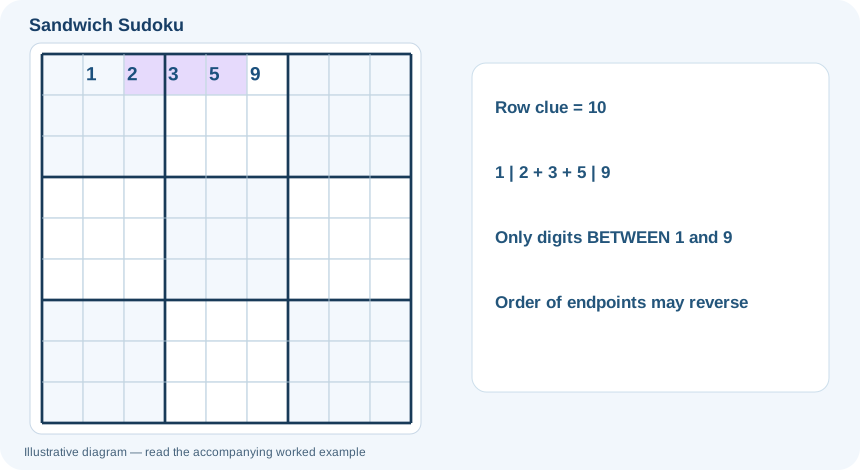
Learn the extra rules, then answer a practice question with immediate feedback. This lesson does not change your player account or game progress.
Find the bread digits
The digits 1 and 9 form the ends of the sandwich in each relevant row or column. They may appear in either order.
Count only the digits between them
If a row begins 1, 2, 3, 9, the sandwich sum is 2+3=5; the endpoints 1 and 9 themselves are not included.
Use an edge clue carefully
A zero sum means 1 and 9 are adjacent in that row or column. Nonzero sums restrict the number and identity of intervening digits.
What the outside clue measures
Sandwich Sudoku retains the ordinary row, column and 3×3 box rules. A clue outside the grid describes the sum of digits strictly between 1 and 9 in that row or column. It does not include either endpoint, and their left-to-right or top-to-bottom order may be reversed. If the endpoints are next to each other, the sandwich sum is zero.
Worked row: a sandwich worth 10
Suppose a row has 1 in column 2 and 9 in column 6. The cells in columns 3, 4 and 5 are the filling. If their digits are 2, 3 and 5, then the clue must be 2+3+5=10. Other digits outside columns 2–6 do not contribute. In the diagram those three middle cells are shaded. This is an arithmetic illustration rather than a claim that the rest of a Sudoku grid is solved.
Calculate bounds and test endpoints
Identify possible positions of 1 and 9 first, using normal Sudoku constraints. For each pair of endpoints count how many cells lie between them. A clue of 0 demands adjacent endpoints; a nonzero clue needs at least one interior cell. Compare the clue against minimum and maximum sums available from distinct digits that could occupy the interior cells. Remove endpoint pairs that make the clue impossible.
Practice
The row clue is 7. If 1 is in column 3, 9 is in column 6, and the intervening cells are 2 and 5, the clue is satisfied. If the cells were 2 and 6 instead, their sum would be 8 and the placement would contradict the clue. Always continue checking column and box restrictions before fixing a number.
Check your understanding
In the row segment 1, 2, 3, 9, what is the sandwich sum?
Reason about the gap, not the endpoints
Only interior digits count
The external clue sums cells strictly between 1 and 9 in its row or column. If 1 and 9 are adjacent, the sandwich sum is zero. Their order does not matter, and no digits outside those boundaries are included.
A sum of six has few options
For a clue of 6, a one-cell interior must contain 6. A two-cell interior can contain 2 and 4 in either order; it cannot contain 1 because 1 is one of the boundaries. A three-cell interior would total at least 2+3+4=9.
Check the line against the grid
Try candidate positions for the two boundary digits, then calculate legal interior combinations. Reject any that conflict with fixed digits in the row, column or box. Do not infer exact positions from the sum alone.