Sudoku variant course
Killer Sudoku
Sudoku rules plus outlined cages with a target sum; digits cannot repeat within a cage.
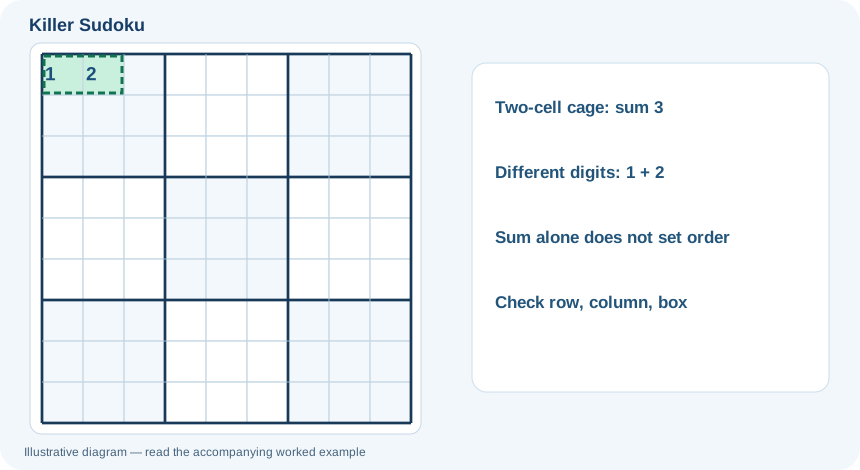
Learn the extra rules, then answer a practice question with immediate feedback. This lesson does not change your player account or game progress.
Read the cage target
A cage's small corner number is the sum of all digits in that outlined cage. Determine the possible combinations before assigning individual cells.
Use sums to eliminate candidates
In a two-cell cage totaling 3, the only distinct digits are 1 and 2. Their order still depends on row and column constraints.
A cage is not a free arithmetic guess
A combination that matches a sum is not automatically legal: repeated digits in a cage are forbidden, and row, column and box restrictions still apply.
Cages are arithmetic constraints, not replacements for Sudoku
Killer Sudoku keeps the normal no-repeat rules for rows, columns and boxes. Every dashed or outlined cage carries a sum, usually printed in a small corner of its first cell. Fill all cage cells with distinct digits whose total equals that sum. A cage may cross box boundaries, but it never exempts a digit from ordinary Sudoku constraints.
Worked two-cell cage: sum 3
The smallest two different digits from 1–9 are 1 and 2, and 1 + 2 = 3. Therefore any two-cell cage totaling 3 must contain exactly {1,2} in some order. Its sum does not tell you which cell is 1. If one of those cells shares a row with an existing 1, that cell must instead be 2; the other becomes 1. Conversely, a proposed pair {1,1} repeats a digit and totals only 2, so it fails both conditions.
Use cage bounds before listing combinations
For two distinct cells the minimum possible sum is 1+2=3 and maximum is 9+8=17. For three cells the minimum is 1+2+3=6 and maximum 9+8+7=24. A three-cell cage totaling 7 must contain {1,2,4}; check the possibilities by comparing each to the minimum. For a cage enclosed within a row, column or box, the ordinary unit restrictions help reduce the possible placements further.
Practice with pencil marks
Choose a two-cell cage labeled 10. Write the possible unordered distinct pairs {1,9}, {2,8}, {3,7}, {4,6}. Now cross out any pair incompatible with digits already fixed in the shared row, column or box. Only when a cell has one remaining candidate may you enter its value. Do not infer an order solely from the sum.
Check your understanding
Which digits can fill a two-cell cage with a sum of 3 and no repeated digits?
Cage bounds and combinations
Fast minimum and maximum
For a cage with three distinct 1–9 digits, the smallest sum is 1+2+3=6 and the greatest is 9+8+7=24. A cage marked 5 with three cells is impossible under normal Killer Sudoku rules. Use these bounds to catch mistakes early.
Prove a small cage
A three-cell cage totaling 7 has just one unordered set of digits: {1,2,4}. This does not identify their positions. If one candidate cannot enter a given cell because its column already contains that digit, eliminate that placement and re-evaluate the remaining orders.
Cross-check units
When a cage crosses a region boundary it retains the sum and no-repeat cage rules; its cells also obey their original row, column and box. Do not assume cage shapes replace ordinary Sudoku boxes.