Sudoku variant course
Jigsaw Sudoku
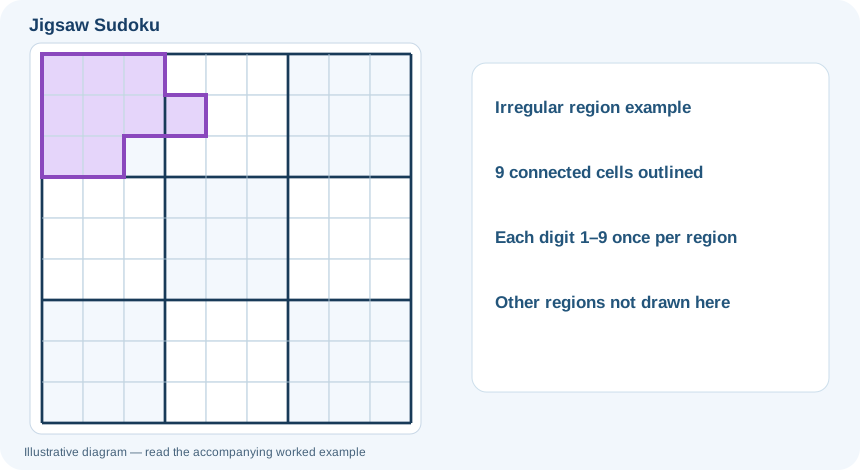
Instead of nine ordinary 3×3 boxes, the board has nine outlined irregular regions of nine cells each.
Learn the extra rules, then answer a practice question with immediate feedback. This lesson does not change your player account or game progress.
Follow the outlined shapes
Every row and column still contains 1–9. A region is identified by its irregular thick outline, not by an ordinary square.
Check membership before a move
A cell may look physically close to another but belong to a different outlined region. Only cells within the same actual region share the region constraint.
Use a color or outline trace
Trace one irregular region and count nine cells. Mark its present digits and missing set, then intersect with each candidate's row and column.
The irregular region is the box replacement
Jigsaw Sudoku has nine rows and nine columns just like Classic. Its nine regions still hold nine cells each, but their outlines bend instead of forming 3×3 squares. Each region must contain 1–9 exactly once. Follow the thick region boundary carefully: a cell near an ordinary 3×3 boundary may now belong to a region that stretches into a different area.
Worked region-based elimination
Imagine an outlined region already holds 1,2,3,4,5,6,7 and 8. The ninth remaining cell must be 9, provided its row and column permit it. Unlike Classic, the region is defined by the actual outline rather than the cell coordinates. In the diagram, a highlighted nine-cell connected shape illustrates one possible irregular region; the complete set of other regions is not shown, so do not treat it as a full Jigsaw puzzle.
How to scan without losing track
Choose one outlined region and trace its entire boundary, then write which digits are missing. For every empty cell, intersect the allowed region digits with those allowed by its row and column. Look for a missing digit with only one possible position. Repeat region by region. If the outline is hard to read, lightly shade alternating regions or mark region membership before entering candidates.
Practice question
If a nine-cell region already contains eight different digits except 6, what value must its last cell hold? Answer: 6, assuming the eight entries obey all Sudoku rules. Then identify why two cells separated by a traditional 3×3 border might still exclude one another in Jigsaw Sudoku: they may lie in the same irregular region.
Check your understanding
What replaces ordinary 3×3 boxes in Jigsaw Sudoku?
Irregular regions are real units
Follow the outlined region
Jigsaw replaces ordinary 3×3 boxes with irregularly shaped regions, normally nine cells each on a 9×9 board. Every outlined region still requires digits 1–9 once. A region may bend through multiple rows and columns: draw its exact member cells before eliminating candidates.
Avoid invisible boxes
Suppose two highlighted cells sit in the same geometrical 3×3 square but belong to different outlined regions. Their region membership does not create a new exclusion between them. Ordinary row and column conflicts still matter; the fictitious 3×3 boundary does not.
Practice a true hidden single
Pick one irregular region, note which digits it still needs, and test every empty member cell against row and column restrictions. If only one member cell can accept a digit, you have a regional hidden single. Confirm the printed boundary before placing it.