Start with three cells, not three guesses
XY-Wing is a Sudoku candidate pattern built from three unsolved cells. The pivot contains exactly two candidates, x and y. A first pincer that sees the pivot contains exactly x and z. A second pincer that sees the pivot contains exactly y and z. Here 'sees' means sharing a row, column or 3×3 box. Every one of these three cells must genuinely have only the two stated candidates. A cell with a third candidate can break the either-or proof, even if the markings look similar at first glance.
A coordinate example you can draw
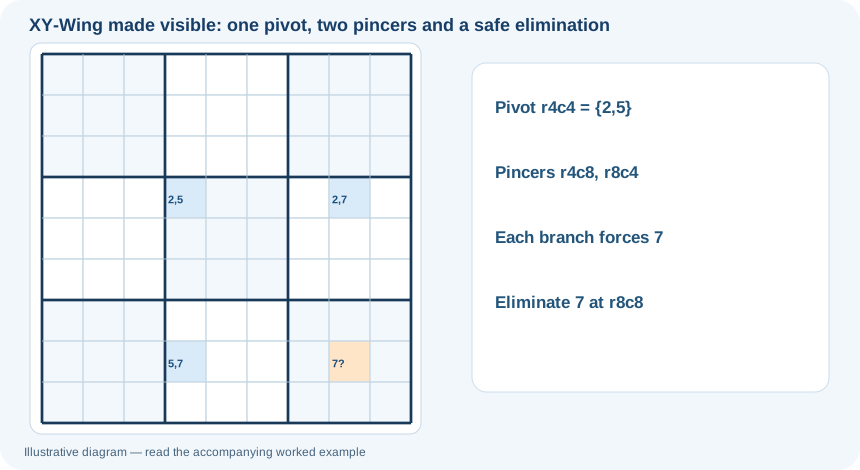
Use these hypothetical candidates: pivot r4c4 = {2,5}, first pincer r4c8 = {2,7}, and second pincer r8c4 = {5,7}. The pivot sees the first pincer along row 4 and sees the second along column 4. Both links are valid. The pincers do not have to share a Sudoku unit with each other. Now inspect r8c8: it shares column 8 with r4c8 and row 8 with r8c4. If 7 is among the candidates at r8c8, this pattern can eliminate that 7. The diagram is a candidate-level illustration, not a claim that a particular supplied puzzle contains these marks.
The proof has just two branches
The pivot at r4c4 must eventually be 2 or 5. If it is 2, r4c8 cannot be 2 because the cells share row 4; therefore its {2,7} pair resolves to 7. If the pivot is 5, r8c4 cannot be 5 because it shares column 4; therefore its {5,7} pair resolves to 7. In either case, at least one pincer will contain 7. Since r8c8 sees both pincers, it cannot hold 7. Notice what we did not prove: we did not prove whether the pivot is 2 or 5, and we did not solve either pincer outright.
Where the elimination may happen
Only remove z from a cell that sees both pincers. A cell that sees the pivot and only one pincer is not automatically eligible. The common peers of the two pincer cells are the elimination targets, and there may be several or none with the z mark. Also beware of a deceptively similar triple in which r4c8 still permits another digit such as 9: its pair would not actually be {2,7}, so the proof fails. A real XY-Wing is strongest when every candidate list is checked first.
Practise the pattern without memorising coordinates
Begin with a candidate grid and circle cells that contain exactly two marks. Choose one as a pivot and identify two cells it sees whose candidate sets take the form {x,z} and {y,z}. Verify both links and write the two conditional branches on paper. Only then search for cells that see both pincers and contain z. If none exist, the XY-Wing is valid as a relationship but yields no current elimination. This is a useful distinction: spotting a pattern and making progress with it are separate achievements.
Each wing must share the right digit
The pivot has {X,Y}, one wing has {X,Z} and the other {Y,Z}. Both wings see the pivot; a target for eliminating Z must see both wings. If any selected cell has a third candidate, or if the target sees only one wing, the conclusion is not justified.