
Locate the pivot
Suppose pivot candidates are {1,2} with two peers that can see it: wing A {1,7} and wing B {2,7}.
New guided lesson 14 · Advanced · Three-cell chains
Use three two-candidate cells to prove an elimination visible to both wings.
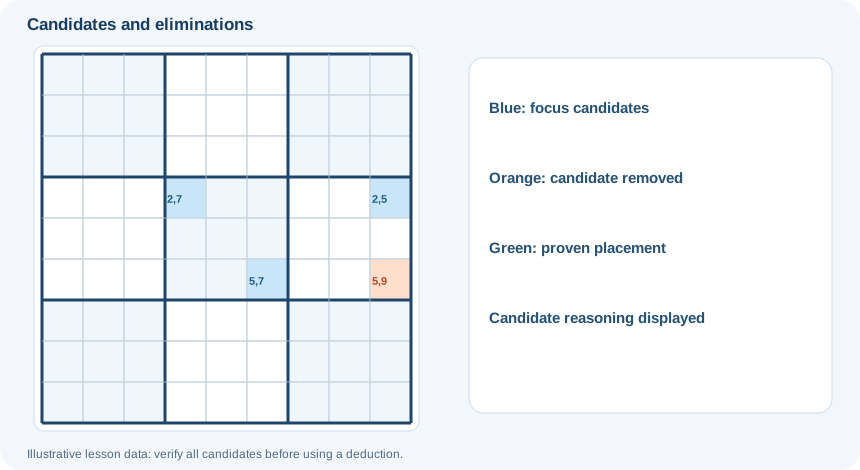
An XY-Wing has pivot {X,Y}, a wing {X,Z} and another wing {Y,Z}; each wing must see the pivot.
The pivot r4c4 has {2,7}. Wing r4c9 has {2,5} and sees the pivot along row 4. Wing r6c6 has {5,7} and sees the pivot within their shared 3×3 box. If the pivot is 2, r4c9 must be 5; if it is 7, r6c6 must be 5. Either way, at least one wing is 5. The cell r6c9 sees both wings (same column as the first and row as the second), so 5 can be removed from r6c9.
Schematic candidate positions, not a complete Sudoku puzzle. Unshown cells are intentionally omitted: verify all required candidates in a real puzzle before applying the rule.
Three-cell chains
Verify that each of the three cells has exactly two candidates, that each wing shares a unit with the pivot, and that the target shares a unit with BOTH wings. Remove the shared third digit Z from the target, not from the pivot or a wing.
Candidate 5 is removed from r6c9, leaving 9 as its only candidate in this schematic example.
A target that sees only one wing is not valid. Do not infer any fixed digit in the pivot or the wings from this elimination alone.
Pivot r4c4 contains {2,7}. If it is 2, pincer r4c9 cannot be 2 because the cells share row 4; with candidates {2,5}, that pincer must be 5. If the pivot is 7, pincer r6c6 cannot be 7 because the cells share the central box; with {5,7}, it must be 5. Both cases force 5 into one of the pincers. Target r6c9 sees both pincers, so 5 is removed from its candidates.
Why not remove 5 from a cell that sees only one pincer? The other branch may leave that 5 entirely possible.
Why may r6c9 lose candidate 5?
Suppose pivot candidates are {1,2} with two peers that can see it: wing A {1,7} and wing B {2,7}.
If the pivot is 1 one wing must be 7; if it is 2 the other wing must be 7.
Remove 7 only from cells that can see both wings, never from every cell around the pivot.
A pivot {2,7} seeing wings {2,5} and {7,5} forces a 5 in at least one wing. A target seeing BOTH wings cannot contain 5.
In the published interactive example, pivot r4c4, wing r4c9, wing r6c6, and target r6c9 establish this exact candidate-level deduction.
A valid XY-Wing uses a pivot cell with candidates {x,y}, a first wing {x,z}, and a second wing {y,z}. Both wings see the pivot. If the pivot is x, the first wing must be z; if the pivot is y, the second wing must be z. Thus at least one of the wings is z.
A cell that sees both wings cannot contain z, because in either pivot case one wing takes z. But a cell that sees only one wing does not qualify for the elimination; the other wing may be the one carrying z. Seeing means sharing a row, column or box.
Check that every participating cell has exactly two candidates and that the pivot can see each wing. The two wings need not see one another, and the arrangement need not resemble a literal letter Y on the grid.
An XY-Wing uses a pivot with exactly {X,Y}, one wing with {X,Z}, and another with {Y,Z}. Both wings must see the pivot under Sudoku's row, column or box rules. When the pivot is X, the first wing must be Z; when the pivot is Y, the second wing must be Z. Therefore at least one wing is Z.
Take pivot r4c4 {2,7}; wing r4c9 {2,5}, which shares its row; and wing r6c6 {7,5}, which shares the pivot's central 3×3 box. Cell r6c9 sees r4c9 in column 9 and sees r6c6 in row 6, so r6c9 cannot be 5 in either pivot case.
Check that the pivot and both wings are genuinely two-candidate cells; an extra candidate invalidates the forced-case argument. Check that both wings see the pivot and the eliminated target sees both wings. The XY-Wing usually removes one candidate; it need not determine any of the three wing or pivot values immediately.
Illustrative candidate positions are not universal puzzle solutions; verify all constraints on your current board.