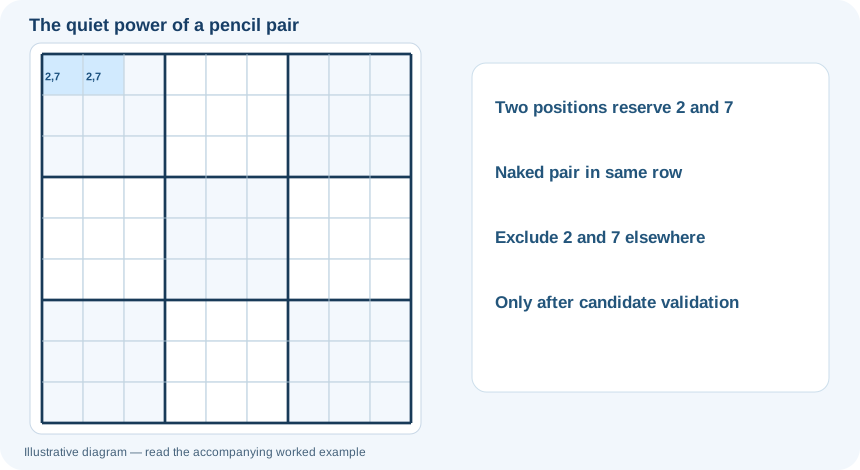
When two cells reserve two digits
Imagine two empty cells in the same row. After checking their columns and boxes, both allow only 3 or 8. You cannot decide which is 3 and which is 8, but you do know those two digits are reserved for those two cells. No other cell in that row may contain a 3 or an 8.
What to erase
Look at the pencil marks in every other empty cell of that row. Cross out 3 and 8 where they still appear. You may not fill a single square immediately. But an elimination can leave a naked single somewhere else, or reveal that another digit has just one position.
Do not mistake a coincidence for a pair
The two cells must belong to the same row, column or box, and both must have precisely the same two candidates if you are using a naked pair. Merely spotting two squares containing 3 and 8 among several other numbers does not reserve anything. This check prevents many avoidable pencil-and-paper mistakes.
What a real pair rules out
Picture a box with empty cells A and B, each marked {2,7} and nothing else. Those two cells must contain 2 and 7 in some order. Now cell C elsewhere in that box has candidates {1,2,5,7}. You may erase 2 and 7 from C, leaving {1,5}. If another clue later rules out 1, C becomes 5. The pair did not identify its own digits; instead it removed possibilities from neighbours. That indirect effect is its power.
Keep the unit in view
The logic applies within one row, column or 3×3 box. A pair in the same box does not automatically reserve those digits across every row the box touches. Write a small bracket or dot linking the two pair cells and state the unit you are using. After eliminating candidates, pause and scan for new singles before searching for another pair. It is easy to make an impressive-looking page of pencil marks without noticing that one tiny elimination already solved a cell.
Why candidates must be exact
When looking for a naked pair, the word “only” does essential work. If one cell has {2,7} while another has {2,5,7}, they do not form a naked pair, even though both contain 2 and 7. There is still a legal third option in the second cell. Before drawing a bracket around a pair, check the column and box of each candidate cell and confirm that both sets contain precisely two digits. Once the pair is secure, eliminate those digits only from the other cells of their shared unit. This disciplined check prevents the apparent shortcut from introducing a contradiction several moves later.
Compare two different pair deductions
Suppose two cells in row 4 each have exactly {2,7}: they form a naked pair, and those digits can be removed from other row-four cells. A hidden pair is different: if digits 2 and 8 occur only in two locations of a box, extra candidates inside those two cells can be removed. Do not apply the naked-pair elimination rule to a hidden pair without establishing which two digits are exclusive.
A pair reserves digits within one unit
If r3c2 and r3c7 each contain only {4,9}, those digits are reserved in row 3. Candidate 4 or 9 may be removed from other row-3 cells but not from the pair itself. If either cell has another candidate, the proposed naked pair is unproved.