
New guided lesson 11 · Intermediate · Candidate restriction
Hidden pairs: find two digits sharing only two cells
Spot two digits that occur only in the same two cells of a row, column or box, then remove other candidates from those cells.
What the pattern means
Unlike naked pairs, a hidden pair may be concealed among other pencil marks.
Worked candidate example
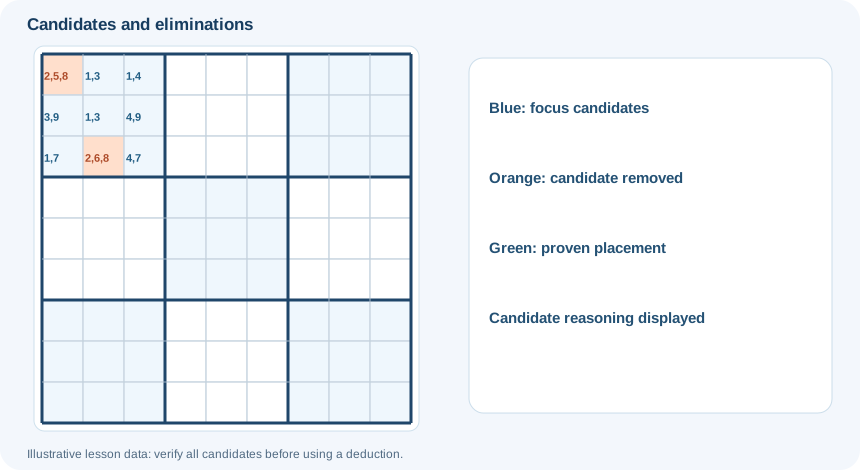
In this illustrative upper-left box, candidates 2 and 8 appear only in r1c1 and r3c2. The first cell also shows 5 and the second also shows 6, but those extra numbers are impossible there: the two restricted cells must contain 2 and 8 in some order.
Interactive candidate laboratory
Schematic candidate positions, not a complete Sudoku puzzle. Unshown cells are intentionally omitted: verify all required candidates in a real puzzle before applying the rule.
Candidate restriction
The rule to verify
Choose a row, column or box and count the positions of each digit. If two different digits can go only in exactly the same two cells, retain those two digits in the cells and delete any other candidates in them. Other cells are not automatically changed by this hidden-pair deduction.
What changed
The extra 5 and 6 are struck out within the two pair cells, leaving {2,8} in both cells.
Avoid this mistake
Two digits merely appearing together in two cells does not prove a hidden pair: each digit must have no other candidate position in the selected unit.
Two exclusive positions within one box
In the upper-left box, the only positions available to digits 2 and 8 are r1c1 and r3c2. The first cell still lists {2,5,8} and the second {2,6,8}, but both digits must occupy these two cells in some order. Remove 5 from r1c1 and 6 from r3c2; do not yet decide which cell contains 2 or 8.
Check your reasoning
Before claiming a hidden pair, search the entire box for a third position of either 2 or 8. Such a position would invalidate this deduction.
Check your understanding
Which candidates are removed by this hidden pair?
Additional worked reasoning and practice
If only r1c4 and r1c8 can contain digits 3 and 9 anywhere in row 1, those two cells must take 3 and 9 in some order.
Even if the two target cells currently include other notes, you may remove those other notes from the pair cells after verifying both digits have exactly the same two legal positions.
Deeper explanation and guided self-check
Two digits can be hidden among extra notes
Suppose within one row the digit 2 can appear only at r3c4 and r3c8, and the digit 7 can also appear only at those two cells. The two cells must contain 2 and 7 in some order, even if their notes currently include 1, 5 or 9. Remove those other candidates from this pair.
What a hidden pair does not prove
The pair does not tell you which of its two cells is 2. Nor can you remove 2 or 7 from other cells unless their original candidate positions are truly limited to those same two cells in the unit. Always examine the complete row, column or box before making the elimination.
Practice the distinction
A naked pair starts from two cells already having exactly the same two notes. A hidden pair starts from two digits that have nowhere else to go in the unit. Both reserve two positions, but you discover them from opposite directions.
Go further: detailed reasoning and practical examples
Count the positions of digits
A hidden pair is proved within one full unit. Suppose in row 6, digit 3 can appear only at c2 or c7, and digit 8 can also appear only at c2 or c7. Even if those two cell notes include other numbers, row 6 must place 3 and 8 in the two shared positions, one digit in each.
Clean the pair cells
If r6c2 is marked {2,3,8} and r6c7 is marked {3,5,8}, remove 2 from the first and 5 from the second. You have not proved which cell is 3. You have only reduced them to {3,8}. Unlike a naked pair, the key evidence was the digit-position scan across the whole row.
Use a complete position map
Inspect every other empty position of row 6. If another cell permits 3 or 8, the stated hidden-pair proof is incomplete. In a box or column the same principle applies: the two digits must have no legal homes elsewhere in that same unit.
Illustrative candidate positions are not universal puzzle solutions; verify all constraints on your current board.