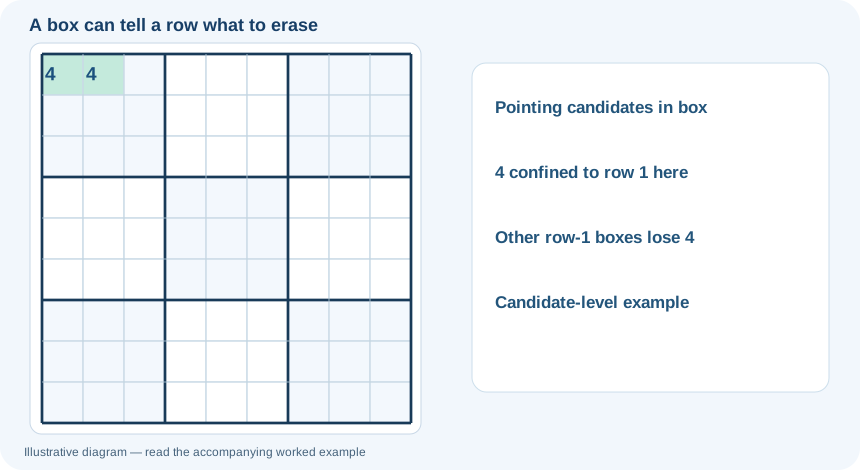
Picture the top-left box
You want to place a 4 in the upper-left 3×3 box. Suppose the only remaining cells that could take 4 are both in its top row. You do not yet know which of those two cells is correct, but wherever 4 lands inside that box, it will be in that top row.
What follows outside the box
The same row cannot contain another 4. Therefore 4 can be removed from all other empty cells in that row beyond the three columns of the upper-left box. The new restriction came from looking at a box, yet its effect travels across the row.
Make your notes explain the move
On paper, draw a tiny dot next to the confined candidates, then lightly strike 4 from affected cells outside the box. Do not cross out 4 within the pair of original positions: one of them still needs it. Repeat the idea with columns as well as rows. This is the basic logic behind pointing locked candidates.
The same idea can travel by column
A pointing candidate need not be restricted to a row. Suppose the only possible positions for 9 in the middle-right 3×3 box lie in its centre column. The box must contain one 9, therefore that column receives its 9 inside the box. Any 9 pencilled elsewhere in the same column, above or below that box, is impossible. A deduction observed in a local box produces a useful consequence along the full column.
Why this is not guessing
You never choose which of the two candidate cells holds 9. You reason only that one of them must. That is enough to eliminate 9 from cells outside the box in the aligned column. Check the premises carefully: if you overlooked a third possible 9 inside the box in another column, the elimination would be unjustified. Practise the technique with a finger following the row or column across the paper; the geography of the cells makes the logic easier to remember.
A pencil exercise worth repeating
On your next printed puzzle, focus on a box that is missing several copies of possibility—not actual repeated digits, since each digit appears only once. Pick one missing digit and mark every cell inside the box where it could go. If all the marks align in one row, draw a faint line along that row outside the box. Each cell touched by that line must reject the chosen digit as a candidate. If the marks spread across two or three rows, the technique does not apply yet; leave them alone. Learning when NOT to eliminate is as important as recognising a valid pointing pattern.
Follow the logic of the removal
In the interactive lesson, the upper-left box allows candidate 7 only at r2c1 and r2c3. Its 7 must therefore occupy row 2. You may delete candidate 7 from r2c5 and r2c8, but not from an unrelated cell outside that row. Compare the candidate grid before and after the deduction and explain why each crossed-out 7 shares the affected unit.
Check outside the intersection
If all candidate 7s of a box lie in row 2, remove 7 only from row 2 outside that box. Do not remove the candidate from the box cells that establish the pattern. A third legal position elsewhere in the box invalidates this particular pointing deduction.