
Find 4 inside a box
If candidate 4 occurs in just two cells of a 3×3 box and both share a row, it is locked to that row within the box.
New guided lesson 10 · Intermediate · Box–line interaction
Understand why candidates confined to one row inside a box can be removed elsewhere in that row.
A number can be restricted to a particular row or column without its exact cell being known.
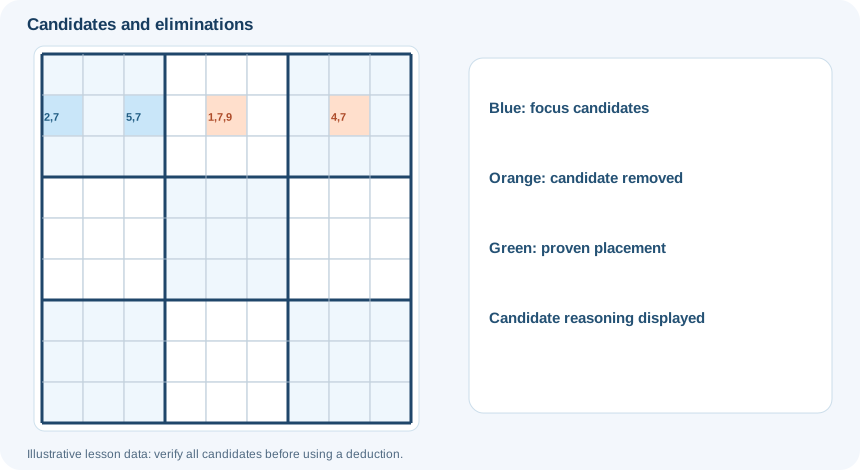
In the upper-left 3×3 box, the illustrated candidate 7 occurs only at r2c1 and r2c3. Both lie in row 2, so the box must place its 7 in row 2. That rules out 7 at r2c5 and r2c8, outside that box. This is a pointing elimination; no value is placed yet.
Schematic candidate positions, not a complete Sudoku puzzle. Unshown cells are intentionally omitted: verify all required candidates in a real puzzle before applying the rule.
Box–line interaction
Inspect all candidate positions for one digit inside a single box. If they share one row or column, remove that digit from the rest of the shared line outside the box. The reverse pattern is called claiming: if all candidates for a digit in a row or column lie in one box, remove the digit from other cells of that box.
The two red 7s can be removed from row 2 outside the box. Recheck the affected cells for newly formed singles.
Do not use this rule unless the illustrated candidates are the complete positions for that digit within the relevant box or line. A third position elsewhere in the box would invalidate the pointing deduction.
Inside the upper-left 3×3 box, digit 7 is possible only at r2c1 and r2c3. Both cells lie in row 2. Thus the box must place its 7 somewhere in that row, and row 2 cannot contain another 7 outside the box. Remove 7 from r2c5 and r2c8.
If r1c2 were also a legal 7 inside the box, could you keep the elimination? No: the box might place 7 outside row 2.
Where is candidate 7 eliminated in this example?
If candidate 4 occurs in just two cells of a 3×3 box and both share a row, it is locked to that row within the box.
Eliminate 4 elsewhere in the row outside the box; one of those two cells must receive it.
A third possible 4 in another row inside that box invalidates the elimination.
If all candidate 7 positions inside one box lie in row 2, that box's 7 must occur somewhere in row 2. Remove 7 from cells in row 2 OUTSIDE that box.
The reverse, claiming, occurs if all positions for digit 7 in a row lie in one box: you can remove 7 from the other cells of that box.
If every remaining candidate 5 inside one 3×3 box lies on the same row, that box must place its 5 somewhere on that row. Therefore candidate 5 can be removed from other cells of that row outside the box. The box constraint creates the elimination, not the shape of the candidate marks alone.
If within a row every possible 5 is located in a single 3×3 box, that row must place its 5 inside that box. Hence other cells inside the box but outside the row cannot be 5. Claiming reverses the viewpoint: it starts with the row or column rather than the box.
This is an elimination technique, not an immediate instruction to fill a cell. Keep the candidate in the two or three cells that remain eligible inside the locked segment, and remove it only where the logic actually forbids it.
Suppose a 3×3 box has candidate 7 only at r2c1 and r2c3. Both positions lie in row 2, so this box's 7 must occupy row 2. Candidate 7 can therefore be removed from other row-2 cells outside that box, such as r2c5 if it currently lists 7. You cannot choose which of the two box cells is 7 yet.
If a row's only possible positions for digit 4 all belong to the same box, then that row must place 4 inside that box. Remove 4 from other cells of the box outside that row. The reasoning is about the confinement of the digit's positions—not the fact that several highlighted notes happen to share a color.
A third position for 7 in another row of the original box destroys the pointing proof. Likewise, claiming fails if the source row has another legal 4 outside the selected box. Scan the complete unit and make only eliminations outside the intersection of the restricted box and line.
Illustrative candidate positions are not universal puzzle solutions; verify all constraints on your current board.