Read the cage rule before the sum
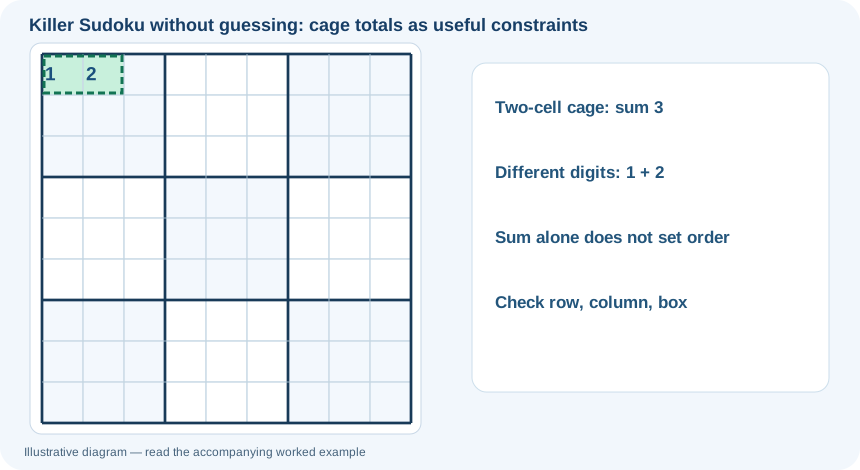
In the usual Killer Sudoku variant, the rows, columns and 3×3 boxes obey ordinary Sudoku rules. A dashed cage adds a sum: the digits in that cage must total the printed number, and digits do not repeat inside the cage. A cage may cross a box boundary. Its sum is therefore not a substitute for Sudoku logic; it is one more restriction. Check your game's stated cage rules first, because a puzzle variant may change the no-repeat convention or add extra constraints.
Minimum and maximum are your first filters
With distinct digits from 1 to 9, the smallest sum for a two-cell cage is 1+2=3, and the largest is 8+9=17. For three cells, the limits are 1+2+3=6 and 7+8+9=24. Four distinct digits cannot total less than 10 or more than 30. This offers an immediate consistency check and often cuts the candidate list before any normal row or box deduction. It does not tell you the order of the digits inside a cage; orientation comes from the ordinary Sudoku restrictions.
Two cages with almost no arithmetic
Consider a two-cell cage with total 17. If the digits must differ, the only possible pair is {8,9}. You can pencil 8 and 9 in both cells, then use their rows, columns and boxes to decide the order. A three-cell cage with total 6 similarly forces the set {1,2,3}. These are sets, not completed placements. In particular, if a cell in the total-6 cage shares a row with a given 1, that cell cannot take 1; the other two cells must distribute the remaining possibilities. Every elimination should cite a Sudoku unit or a cage sum.
Use the 45 rule carefully
Every complete row, column or 3×3 box in ordinary Sudoku contains 1 through 9 exactly once, so its digits sum to 45. If a row is covered by cage fragments, adding the complete cage totals and subtracting the portions lying outside the row may reveal the value of an unresolved cell. But a cage crossing the row boundary must not be counted as if all its digits belonged to that row. Sketch the boundary first. The arithmetic works because the full row sums to 45; the crossing cage still contributes only its relevant cells.
An elimination example, not a guess
Suppose a two-cell 17 cage contains cells A and B and A's row already contains 9 elsewhere. Since the cage must be {8,9}, A cannot be 9 and must be 8; B must be 9. This is a forced deduction provided the given 9 is in the same row and all original constraints are valid. By contrast, if neither cell sees an 8 or 9 already placed, writing 8 in A because it feels likely is a guess. Leave the pair pencilled until another unit distinguishes the cells.
A practical solving order
Start with the unusually low or high cage totals, then check whether a row or column is nearly accounted for. For each short cage, list combinations of distinct digits—not ordered permutations—and remove combinations that conflict with visible givens. Only after narrowing the combinations should you assign candidates to individual cells. Revisit row and box singles after each forced assignment. If your notes grow, keep separate marks for 'cage membership' and 'cell possibility'; confusing these two kinds of information is a common source of false placements.
Use the shortest possible bound proof
Three different digits have a minimum sum of 1+2+3=6. A three-cell cage marked 5 cannot follow the usual distinct-digit Killer rule. Checking this bound before enumerating combinations saves unnecessary work and may reveal a transcription error.