
New guided lesson 15 · Expert · Fish patterns
Swordfish: three rows and three columns
Extend fish-pattern logic to three rows with candidate positions restricted to three matching columns.
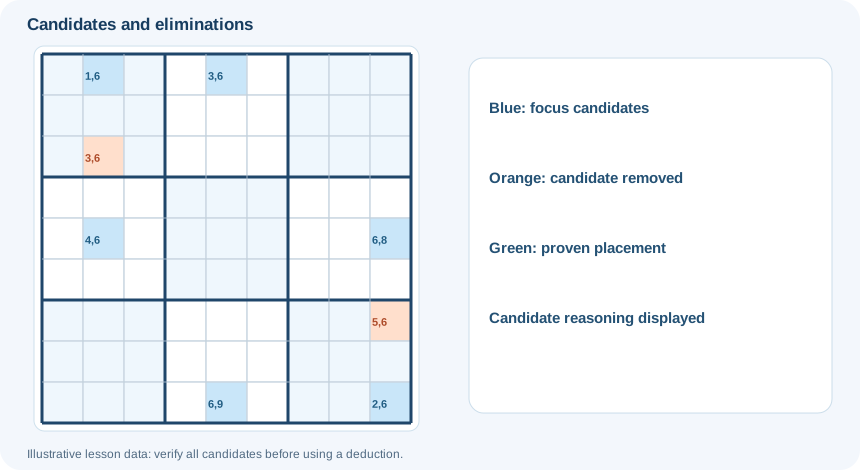
What the pattern means
Swordfish is a three-line analogue of X-Wing, and works on one digit at a time.
Worked candidate example
For digit 6, row 1 has candidate columns 2 and 5, row 5 has columns 2 and 9, and row 9 has columns 5 and 9. All possible positions of 6 in these three rows lie within the same three columns {2,5,9}. The three rows need three 6s, each in a distinct column. So candidate 6 in r3c2 and r7c9, outside the source rows, can be removed.
Interactive candidate laboratory
Schematic candidate positions, not a complete Sudoku puzzle. Unshown cells are intentionally omitted: verify all required candidates in a real puzzle before applying the rule.
Fish patterns
The rule to verify
Choose one candidate digit and three source rows, each with two or three possible positions restricted to a union of exactly three columns. If every row must still contain the digit, those three rows collectively reserve one placement in each of the three columns. Remove the digit from other rows in those columns. The column-oriented version is symmetric.
What changed
Remove candidate 6 from r3c2 and r7c9; keep all six illustrated source candidates until a further deduction is proven.
Avoid this mistake
Do not accept a Swordfish if one of its source rows has an additional candidate in a fourth column or if the chosen columns do not form the claimed restricted union.
Three source rows reserve three columns
For candidate 6, source rows 1, 5 and 9 have their legal positions confined to columns 2, 5 and 9. Each source row must place one 6, and a column cannot contain 6 twice. Together those rows use the three designated columns, leaving no additional 6 at r3c2 or r7c9 outside the source rows.
Check your reasoning
Do not assume every source row must have all three candidates. Its possible locations must be restricted to the same three columns; verify the actual candidate grid first.
Check your understanding
Which candidate is eliminated by this Swordfish?
Additional worked reasoning and practice
For digit 6, if three source rows have all their legal candidates restricted to the same three columns, those rows reserve three placements of 6 in the columns.
In the published exercise, rows 1, 5 and 9 use columns 2, 5 and 9. Remove 6 from columns 2, 5 and 9 only OUTSIDE the three source rows.
Deeper explanation and guided self-check
Track exactly three source lines
For one digit, select three rows where all available placements fall within the same three columns, with two or three eligible places per selected row. Because the three rows each need one occurrence of that digit, the three target columns are reserved across those rows.
Where elimination is allowed
You may remove the digit from other rows in those three columns. You must not remove it from the selected source-row positions or from columns outside the pattern. The column-first version is symmetric: choose three columns and eliminate from rows instead.
Distinguish Swordfish from a picture
Candidate marks forming a three-by-three-looking shape do not prove Swordfish by themselves. Verify all possible placements for the digit in each source line; a fourth candidate outside the selected three columns breaks that source-line condition.
Go further: detailed reasoning and practical examples
Three lines confine a digit to three cross-lines
Swordfish generalizes fish logic: for one digit, three source rows have all their candidate positions inside the same set of three columns. Each source row still needs that digit exactly once, and no column can host it twice. If this placement arrangement is feasible, those source rows account for the candidate's three placements across the three selected columns.
What a safe elimination looks like
Suppose for digit 6 the source rows are 1, 5 and 9, and all legal positions in each lie within columns 2, 5 and 9. Any candidate 6 in those three columns but outside rows 1, 5 and 9 may be eliminated. The source candidates themselves remain because the pattern does not pick a specific position in any source row.
Check the pattern rather than its name
Each chosen source row must have at least two and at most three available locations for the digit, all restricted to the selected columns. A fourth candidate column breaks the specified row pattern. A column-oriented Swordfish exchanges rows and columns; no arithmetic sum or diagonal constraint is part of the Classic Swordfish rule.
Illustrative candidate positions are not universal puzzle solutions; verify all constraints on your current board.