
New guided lesson 12 · Intermediate · Candidate combinations
Naked triples: three cells reserve three digits
Combine three candidate lists correctly and eliminate their shared digits from the rest of a unit.
What the pattern means
A naked triple can contain cells with two or three candidates; they do not all have to list the same three digits.
Worked candidate example
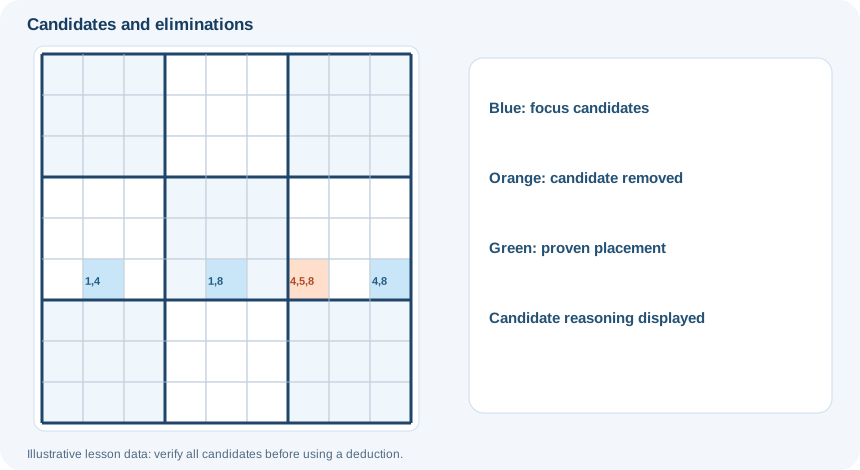
In row 6, r6c2 has {1,4}, r6c5 has {1,8}, and r6c9 has {4,8}. Together the three cells use exactly the three digits {1,4,8}. Those digits must occupy the three cells, so r6c7 cannot contain 4 or 8 and is left with 5.
Interactive candidate laboratory
Schematic candidate positions, not a complete Sudoku puzzle. Unshown cells are intentionally omitted: verify all required candidates in a real puzzle before applying the rule.
Candidate combinations
The rule to verify
Find three unsolved cells sharing a row, column or box. Their combined distinct candidates must have exactly three values, and each cell must use only these values. Remove those three values from any other cells in the SAME unit.
What changed
After removing 4 and 8 from r6c7, its only remaining candidate is 5.
Avoid this mistake
Do not confuse a union of four candidates with a triple, and do not eliminate digits from a different region that only touches one of the cells.
Three cells reserve exactly three digits
Row-six cells r6c2, r6c5 and r6c9 have candidates {1,4}, {1,8} and {4,8}. Their union is exactly {1,4,8}; these three digits must fill those three cells in some order. No other cell in row 6 can use any of them. Cell r6c7 begins with {4,5,8}; removing 4 and 8 leaves a naked single 5.
Check your reasoning
If one triple cell had {1,4,9}, would the same proof work? No: the union would now contain four digits.
Check your understanding
What is the remaining candidate for r6c7?
Additional worked reasoning and practice
Three cells in a unit form a naked triple when their combined candidates contain exactly three digits, such as {1,4}, {1,8}, and {4,8}.
Remove 1, 4 and 8 from other cells in that unit, never from the triple cells themselves. A fourth distinct candidate means the simple triple proof fails.
Deeper explanation and guided self-check
Three cells can reserve three digits
In one row suppose the three different cells have notes {1,4}, {1,7} and {4,7}. Although none is solved, collectively these cells must contain 1, 4 and 7 in some order. Remove those digits from the other unsolved cells of that row, but do not remove them outside the row unless another unit independently supports it.
A common false triple
Three cells with notes {1,4}, {1,7} and {4,7,9} do not form a naked triple: their union includes four digits. A valid triple needs three selected cells whose combined candidates consist of exactly three different digits in the same unit.
Check your result
After eliminating candidates elsewhere, the three selected cells remain unresolved until a later deduction distinguishes them. A naked triple is about reserving positions, not guessing their order.
Go further: detailed reasoning and practical examples
The union of three candidate sets
A naked triple uses three distinct unsolved cells in one row, column or box whose combined candidates are exactly three digits. For example, if row 5 contains notes {1,4}, {1,6}, and {4,6} in three cells, their union is {1,4,6}. Those three cells reserve the three digits regardless of their final order.
Eliminate only outside the triple
Remove 1, 4 and 6 from the other empty cells of row 5 wherever present. Do not remove these digits from the three selected cells, and do not force a particular assignment without further evidence. If the same three cells also share a box, inspect that box separately for justified eliminations.
Avoid an accidental fourth digit
If any chosen cell has another legal candidate such as 8, the union becomes {1,4,6,8}, so the three-cell proof fails. The three lists need not each contain exactly two digits; what matters is that their complete union contains no more than three distinct candidates.
Illustrative candidate positions are not universal puzzle solutions; verify all constraints on your current board.