
New guided lesson 16 · All levels · Solving workflow
Choose your next Sudoku strategy without guessing
Build a reliable solving order and learn when to switch from singles to pairs, lines and advanced patterns.
What the pattern means
A good solver selects the simplest justified deduction and updates the notes before looking for a harder technique.
Worked candidate example
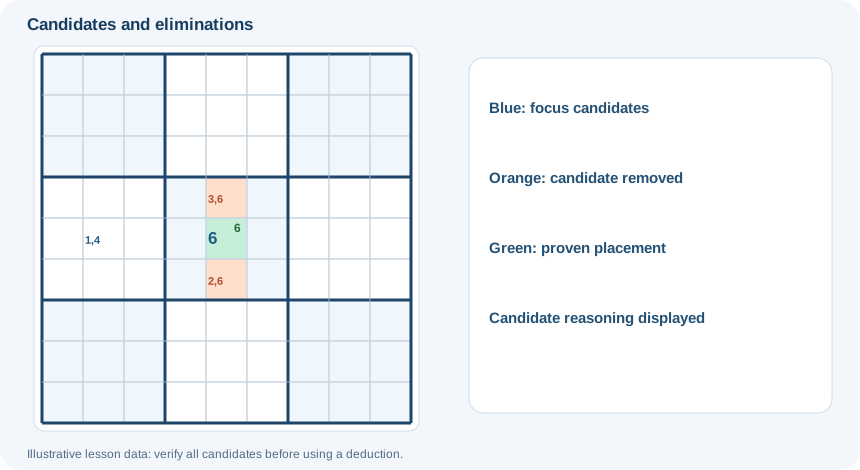
Here the schematic notes show that r5c5 has the sole candidate {6}. Place 6 there first. Because r4c5 and r6c5 are in the same column, they can no longer contain 6. Only after propagating this simple placement should you revisit pairs, locked candidates, X-Wing or chains.
Interactive candidate laboratory
Schematic candidate positions, not a complete Sudoku puzzle. Unshown cells are intentionally omitted: verify all required candidates in a real puzzle before applying the rule.
Solving workflow
The rule to verify
Use this repeatable cycle: (1) verify row/column/box rules, (2) scan for naked and hidden singles, (3) update all peer candidates, (4) search pairs/triples and locked candidates, (5) inspect X-Wing and other advanced patterns, and (6) restart from singles after every elimination. If no safe deduction exists, stop and review rather than guessing.
What changed
Place 6 at r5c5, then delete candidate 6 from its same-column neighbours r4c5 and r6c5.
Avoid this mistake
Choosing the most impressive technique is not the goal. Never place a number based only on two candidates being visible, and never treat schematic training candidates as a fully populated puzzle.
Use the simplest justified deduction first
In the comparison example, r5c5 has exactly one candidate: {6}. You do not need X-Wing or hidden pairs to place it. Once 6 is fixed, eliminate 6 from peers such as r4c5 and r6c5. Then revisit simpler singles before attempting an advanced pattern.
Check your reasoning
After each elimination, ask whether some cell now has a single candidate. One advanced deduction can unlock several straightforward placements.
Check your understanding
What is the first safe move here?
Additional worked reasoning and practice
If any cell has one legal candidate, prefer the direct single. If not, look for a digit with one legal position in a unit, then pointing pairs or wings as needed.
Record the proof for each move: what unit or candidate restriction justified it? This prevents a flashy advanced pattern from becoming an unverified guess.
Deeper explanation and guided self-check
Make your next move explainable
Instead of selecting the most advanced named pattern, ask first which candidate restrictions you can prove. Start with a row, column or box that has few empty cells. If there is no immediate single, compare where a specific digit can still go in each unit. A named technique is useful only if its complete conditions appear on the current grid.
A decision example
Suppose digit 4 appears as a candidate in only one cell of a box. That is a hidden single, even if its cell also has other pencilled candidates. Place 4 and update its peers before hunting for X-Wing. If a box has two candidates for 4 that both lie on the same row, you may instead have a locked-candidate elimination outside that box.
Check your reasoning
Can you name the exact row, column or box that forces the move? If the answer depends on a guess or the uniqueness of the intended solution, step back and verify each remaining candidate.
Go further: detailed reasoning and practical examples
Read the state before choosing a technique
If a cell has one candidate, place the naked single. If a missing digit has one legal position in a unit, use a hidden single. If neither exists, consider pairs, locked candidates and triples. Choose the simplest rule whose full conditions are visible in the notes rather than selecting an advanced technique because the puzzle is labelled difficult.
Compare evidence requirements
A naked pair needs two identical two-candidate cells in one unit; a hidden pair requires checking where each digit may appear throughout that unit. X-Wing requires verifying one digit's complete positions in two source rows or columns. XY-Wing requires exactly three related bivalue cells. Different patterns demand different kinds of candidate evidence.
Review after every step
An advanced elimination can reveal an ordinary single, so return to simpler checks after each confirmed change. When no technique is proved, recompute candidate lists rather than inventing a placement. A reliable solving order is a flexible decision tree, not an obligation to use every named strategy in a single puzzle.
Illustrative candidate positions are not universal puzzle solutions; verify all constraints on your current board.