Start with candidates, not with a shape
An X-Wing is a relationship between possible locations for the same digit. Looking for four marked squares before checking all candidates often creates a convincing but false pattern. Choose one digit, say 7, and write down every cell in each row where it can still go. Ignore other digits for this pass. The question is precise: are there two different rows in which 7 can go in exactly the same two columns? If either row contains a third possible 7, the basic X-Wing proof is missing. It is a candidate argument, not a visual ornament.
A four-corner example you can check
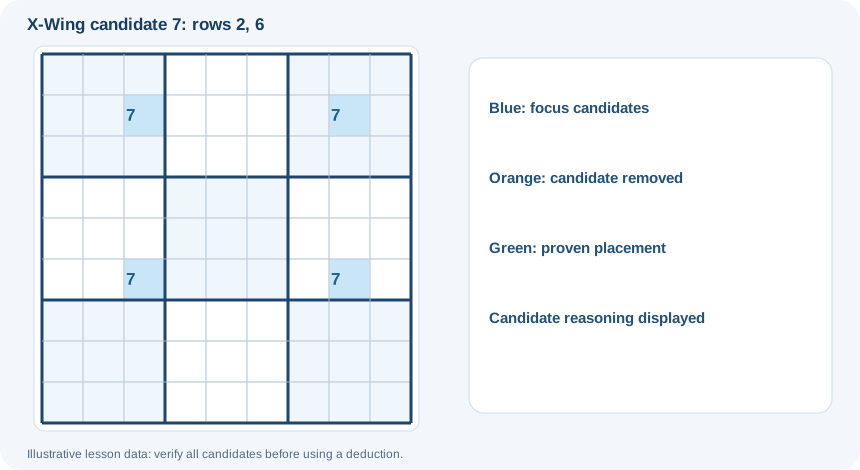
Suppose row 2 admits a 7 only at r2c3 or r2c8. Suppose row 6 admits a 7 only at r6c3 or r6c8. We do not yet know which corner holds the 7 in either row. But each row must contain a 7, and the two rows cannot both choose column 3 or both choose column 8. Consequently those two 7s occupy different corners and cover columns 3 and 8 between them. In this illustrative candidate pattern, other 7 candidates in columns 3 and 8 can be removed; the four corners themselves stay candidates.
What is removed—and what is not
Inspect every other cell in column 3 and column 8, excluding rows 2 and 6. If it contains pencil mark 7, cross out that one mark. Do not delete the whole cell, do not place a 7 in a corner by guess, and do not remove 7 from unrelated columns. After the eliminations, recheck these columns and their intersecting boxes for singles. The reward of an X-Wing may be a later single, not an immediate number placed in one of its four corners. The reasoning remains valid even when the four corner cells contain several other candidates.
Three checks that catch false X-Wings
First, the selected digit must have exactly two candidate positions in each defining row, not merely two interesting positions you happened to circle. Second, the same two columns must appear in both rows. Third, elimination must happen outside the defining rows, along the two shared columns; a candidate elsewhere is not affected. There is also a column-based version: two columns each restrict the digit to the same pair of rows, so eliminations occur in those rows outside the columns. Check the orientation before crossing out a mark.
A short practice routine
Pick one unsolved grid and choose a digit that appears only in a few places across several rows. Make a two-column table on paper: row number on the left, all possible columns for that digit on the right. Search for a repeated pair such as {3,8}. Before making an elimination, say the proof aloud: each defining row needs one 7, so together they occupy both shared columns. If you cannot state that proof, leave the pencil marks untouched. A useful next lesson is the Swordfish, which generalizes this two-row pattern to three.
A rectangle alone is not proof
Four corners marked 6 form a valid row-based X-Wing only if both source rows have no other legal position for 6 outside the same two columns. Before removing 6 from other rows in those columns, inspect every empty cell in each source row.